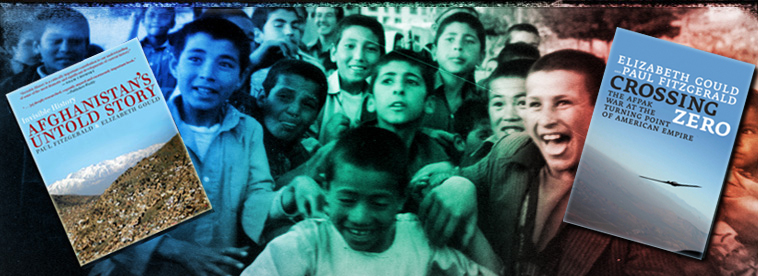
Invisible History:
Afghanistan's Untold Story
Tells the story of how Afghanistan brought the United States to this place in time after nearly 60 years of American policy in Eurasia - of its complex multiethnic culture, its deep rooting in mystical Zoroastrian and Sufi traditions and how it has played a pivotal role in the rise and fall of empires.
Invisible History, Afghanistan’s Untold Story provides the sobering facts and details that every American should have known about America’s secret war, but were never told.
The Real Story Behind the Propaganda (read more)
Crossing Zero: The AfPak War at the Turning Point of American Empire
Focuses on the AfPak strategy and the importance of the Durand Line, the border separating Pakistan from Afghanistan but referred to by the military and intelligence community as Zero line. The U.S. fought on the side of extremist-political Islam from Pakistan during the 1980s and against it from Afghanistan since September 11, 2001. It is therefore appropriate to think of the Durand/Zero line as the place where America’s intentions face themselves; the alpha and omega of nearly 60 years of American policy in Eurasia. The Durand line is visible on a map. Zero line is not.(Coming February, 2011) (read more)
Invisible History Blog
We'll explore anomalies we discovered while researching the causes of the Soviet and American invasions of Afghanistan. We look forward to your comments. Paul & Liz.
Interviews April-May 2011
The Boiling Frogs Presents Gould-Fitzgerald
Elizabeth Gould and Paul Fitzgerald join us to talk about their recently released book, Crossing Zero: The AfPak War at the Turning Point of American Empire. They discuss the origins of the Taliban and the array of armed groups in AfPak that are lumped together as “Taliban” by US media and politicians. Gould-Fitzgerald talk about Pakistan’s double play, the struggle for oil and gas that is the basis for the conflict, pipeline politics, the confused or even lack of strategy in the senseless costly war, the current corruption ridden puppet regime in Afghanistan, Obama administration’s drone-mania, their 8-point plan for ending the US occupation, and more!
*For the history of democracy in Afghanistan, and a detailed recounting of the US support for the Mujahiddin during the 1980′s Soviet occupation, creating some of the “blowback” seen in the current US occupation, listen to Peter B Collins’ recent interview of the Gould-Fitzgerald duo here.
“Hekmatyar and what he represents about U.S. policy in Afghanistan is featured heavily in a new book called Crossing Zero: the AfPak War at the Turning Point of American Empire by Elizabeth Gould and Paul Fitzgerald. Gould and Fitzgerald have a long history of covering Afghanistan. Following from their 2009 book Invisible History: Afghanistan’s Untold Story, in this new book, they explore the war’s expansion into Pakistan, its various contradictions, and consequences for the region.” Apr 4, 2011 -KPFK, uprisingradio.org
-kpfa.org Mar 30, 2011 Pacifica’s Mitch Jeserich hosts “Letters and Politics”
In the News April 2010-April 2011
|
How and Why the Media Misses the Af-Pak Story
“In the years since 9/11 they continued to follow the AF/Pak story closely, ultimately writing a book entitled Invisible History: Afghanistan’s Untold Story. Their latest effort, Crossing Zero: The AfPak War at the Turning Point of American Empire, examines what they call ‘the bizarre and often paralyzing contradictions of America’s strategy’ in the region.” -Rory O’ Connor, AlterNet Apr 14, 2011 Sonali Kolhatkar interviews Paul Fitzgerald and Elizabeth Gould
“Hekmatyar and what he represents about U.S. policy in Afghanistan is featured heavily in a new book called Crossing Zero: the AfPak War at the Turning Point of American Empire by Elizabeth Gould and Paul Fitzgerald. Gould and Fitzgerald have a long history of covering Afghanistan. Following from their 2009 book Invisible History: Afghanistan’s Untold Story, in this new book, they explore the war’s expansion into Pakistan, its various contradictions, and consequences for the region.” Apr 4, 2011 -KPFK, uprisingradio.org -kpfa.org Mar 30, 2011 Pacifica’s Mitch Jeserich hosts “Letters and Politics”
Listen to Elizabeth Gould and Paul Fitzgerald discuss their new book Crossing Zero on KPFA radio.
with host Rose Aguilar -akamai.net Mar 31, 2011
Elizabeth Gould and Paul Fitzgerald discuss Crossing Zero: The AfPak War at the Turning Point of American Empire.
Vast majority of Americans want significant troop withdrawal from Afghan war
“In Elizabeth Gould and Paul Fitzgerald’s book, ‘Crossing Zero’, a dire depiction of a waning U.S. empire is made. As a lone super-power, what if we faced the Truman doctrine of containment—except directed at us—restraining American power instead of protecting it?” -Byron DeLear, Progressive Examiner Mar 19, 2011 CIA drone kills 40 civilians in Pakistan, fuels already-simmering extremism
“A U.S. Predator drone missile strike killed up to 40 innocent civilians in Pakistan’s tribal area on Thursday, outraging Pakistani government and military officials. Prime Minister Yousuf Raza Gilani condemned the ‘irrational’ attack and said it will ‘only strengthen [the] hands of radical and extremist elements.’ Elizabeth Gould and Paul Fitzgerald, two renowned experts on Afghanistan, see this as yet another illustration of waning American power, reminiscent of another empire that tried to once dominate the region.” -Michael Hughes, examiner.com Mar 18, 2011 Is WikiLeaks the antidote to the Washington K Street Kool-Aid?
“Since the end of the cold war, the U.S. had been looking for an enemy to match the Soviet Union and came up empty handed until 9/11. Refocusing the efforts of the world’s largest and most expensive military empire on Al Qaeda would provide the incentive for a massive re-armament, just the way the Soviet “invasion” of Afghanistan had done two decades before. According to a Washington Post report within nine years of America’s invasion of Afghanistan, hunting Al Qaeda had become the raison d’être of the American national security bureaucracy employing 854,000 military personnel, civil servants and private contractors with more than 263 organizations transformed or created including the Office of Homeland Security. The sheer scope of the growth and the extensive privatization of intelligence and security was so profound that it represented ‘an alternative geography of the United States, a Top Secret America hidden from public view and lacking in oversight.'” -Elizabeth Gould and Paul Fitzgerald, Sibel Edmond’s Boiling Points Jul 29, 2010 WikilLeaks: The Pakistan Connection
Paul Fitzgerald and Elizabeth Gould discuss the WikiLeaks Pakistan Taliban connection in a three-part interview. -Paul Jay, The REAL News Network Jul 29, 2010 Drone Escalation or ethical pause after the blowback?
“Paul Fitzgerald has written a brilliant article on the legality, consequences and long term blowback from the policy to continue drone attacks in a sovereign country. He starts off with a conversation between Willam Roper and Sir Thomas More, the Renaissance man in medieval Britain.” -Pakistan Patriot May 17, 2010 Crossing Zero: The Vanishing Point for the American Empire
“The region today delineated as both Afghanistan and Pakistan has known many borders over the millennia, yet none have been more artificial or contentious than the one today separating Pakistan from Afghanistan known as the Durand line but referred to by the military and intelligence community as Zero line. A funny thing happened to the United States when the Obama administration decided to cross Zero line and bring the Afghan war into Pakistan. Instead of resolution, after nearly two years into the administration’s AfPak strategy, it would seem the gap between reality and the Washington beltway has only widened.” -Paul Fitzgerlad & Elizabeth Gould, boilingfrogspost.com May 3, 2010 Elizabeth Gould and Paul Fitzgerald, News Analysis, Pakistan and Afghanistan, Muhammad Khurshid in Tribal Region of Pakistan
“Elizabeth Gould and Paul Fitzgerald provide their expert news analysis on Afghanistan and Pakistan. The threat to these journalists from War Lord Gulbuddin Hekmatyar’s U.S. representative, and in Pakistan. And journalist Muhammad Khurshid describes threats to civilians, journalists, political figures, and others, as a month of April terror continues to unfold in Pakistan. Journalists are being threatened by various forces including government ones, he says, and he blames the US, and US dollars to corrupt actors in the region and leaders is adding fuel to the fires of war.” -Dori Smith, Talk Nation Radio Apr 21, 2010 |
||
Crossing Zero: How and Why the Media Misses the AfPak Story
How and Why the Media Misses the Af-Pak Story
A unique husband and wife team, Paul Fitzgerald and Elizabeth Gould have reported for decades on the issues and conflicts in Afghanistan and Pakistan. In the spring of 1981 they received the first visas to enter Afghanistan granted to an American TV crew and produced an exclusive news story for the CBS Evening News. They also produced a documentary for PBS, returned in 1983 for ABC Nightline, and later worked under contract to Oliver Stone on a film version of their experience.
In 1989 the Soviet Union finally withdrew its forces from Afghanistan, and the Cold War soon ended with the dissolution of the USSR in 1991. But as civil war followed in Afghanistan, the United States also walked away – and in 1994, a new strain of religious holy warrior called the Taliban arose, sweeping into Afghanistan from Pakistan. By 1998, as the horrors of the Taliban regime began to grab headlines, Fitzgerald and Gould began collaborating with Afghan human rights advocate Sima Wali, filming her return from exile and producing another film.
In the years since 9/11 they continued to follow the AF/Pak story closely, ultimately writing a book entitled Invisible History: Afghanistan’s Untold Story. Their latest effort, Crossing Zero: The AfPak War at the Turning Point of American Empire, examines what they call “the bizarre and often paralyzing contradictions of America’s strategy” in the region.
Crossing Zero has been hailed by Daniel Ellsberg as “a ferocious, iron-clad argument about the institutional failure of American foreign policy in Afghanistan and Pakistan,” and praised by filmmaker Stone, who noted that Fitzgerald and Gould “have been most courageous in their commitment to telling the truth — and have paid a steep price for it. Their views have never been acceptable to mainstream media in our country, but they deserve accolades.” Media reformer Norman Solomon, author of War Made Easy: How Presidents and Pundits Keep Spinning Us to Death, called their latest work “a searing expose of distortions that have fundamentally warped U.S. perceptions and actions in the ‘AfPak’ region,” and onetime CIA Senior Soviet Analyst Melvin A. Goodman said it should be “required reading at the National Security Council and the Pentagon.”
I recently interviewed the authors about how the media has reported — and misreported — the ongoing story of the “AfPak war” during the past three decades.
Q: In your book you raise difficult questions and inconvenient truths – why hasn’t mainstream media done the same in your view?
A: As you say, because it’s inconvenient and difficult. Afghanistan was a real crossroads for the American mainstream media, coming on the heels of Vietnam. A lot of journalists and news organizations were being cast in a bad light for allegedly “losing Vietnam” for the United States. Walter Cronkite was reviled in some quarters for giving that famous newscast in February of 1968 calling for a negotiated way out of the American engagement after the Tet offensive.
The Soviet invasion of Afghanistan offered a way out for a lot of budding media stars, who wanted to avoid the inconvenient truths about Vietnam and surf the incoming wave that became the “Reagan Revolution.” Dan Rather inaugurated his ascension to the coveted CBS News anchor chair as Cronkite’s replacement with his Inside Afghanistan special, which established the “Russia’s Vietnam” narrative. They kept framing the narrative to fit the story line… the communist government in Kabul was supposed to collapse as soon as the Russians left, just the way the anti-communist government in Saigon did when the US pulled out. But of course that didn’t happen. The Afghan communists ran the country for three more years until Boris Yeltsin cut off their funding and Afghanistan then descended into chaos.
Q: How is your book an antidote to the mainstream accounts?
A: Mainstream accounts keep repeating the same narrative, which is based on a lot of fabricated information and disinformation and Cold War propaganda that wasn’t true to begin with. Now, even people who should know better can’t tell fact from fiction. What we’ve done from the very beginning is to challenge this artificial narrative with alternative information that broadens the perspective and that sets the record straight.
Some people don’t like what we do because we shatter a lot of illusions. But we’re just reporting and documenting the facts. We’ve done this from outside the mainstream media and without their support for decades now. Even so we’ve recently been acknowledged by some mainstream authorities, who say that our account provides a wider and more helpful perspective.
Q: On page 66, you speak of our ‘distorted image’ of the politics of Pakistan. What do you mean?
A: When it comes to Pakistan, American journalists are helping to sustain a false and deceptive narrative and that’s a real problem. As an example, on the left, Rachel Maddow ought to be challenging the narrative. Instead she looks to Dan Rather and Zbigniew Brzezinski who initiated the crisis. Why? This is a big and profound question that goes to the root of our experience. A lot of our work focuses on the prevailing assumptions that underlie mainstream media’s approach to the outside world. How did we get these assumptions about Pakistan? Most people don’t think about the fact that they’ve had absolutely no choice in influencing American foreign policy. Nor do they understand that the process of choosing an ally is most often self-fulfilling.
Any way you cut it Pakistan is a tough sell. U.S. elites like Brzezinski want Pakistan because it’s a friend to China and a front line state against Russian interests. That results in a lot of very bad things getting intentionally overlooked. We got Pakistan from Britain in 1947. It was largely the creation of Lord Mountbatten, who wanted to retain an Anglo-Saxon military influence in Central Asia, keep the Soviets at bay and stifle the influence of a united, nationalist India. So the territory was divvied up according to what suited this agenda. The U.S and U.S.S.R were the only game in town when the narrative surrounding this process was forming. The U.S. looked to Britain for guidance and got Britain’s agenda, attitudes and long-term strategy in return.
The U.S simply did not have the people with the background in the region, with the languages or the culture. So, relying on Pakistan’s English speaking, British-trained military to run the operation based on a 19th century corporate colonial model was perceived at the time as the only solution. U.S media elites merely bought into the narrative of the Pakistani military elites without ever questioning whether they ought to be challenged. Over time the U.S. became more like them than they became like us, the British/Pakistani assumptions became the American assumptions, became the American media assumptions.
As we enter the second decade of the 21st century these assumptions become less and less valid to the point where accepting them becomes dangerous. The political awakening that is exploding throughout the Middle East is no less desired in Pakistan or Afghanistan. People have had enough with military regimes and terrorists. But look what the U.S. continues to offer them by backing Karzai and Kayani and negotiating with the Taliban. The U.S. is making itself irrelevant. Everybody seems to know there is something very wrong with the lack of leadership here, but nothing really changes because the U.S. media doesn’t challenge the narrative. The realities have changed profoundly since 1947, but Washington steams along as before and the U.S. media steams along with them.
Q: Please supply more detail on what you call the Rendon Group’s “padding the truth” and “neutering journalists” to ensure a “military-friendly and subservient media” in Afghanistan.
A: An August 29, Stars and Stripes story titled “Army used profiles to reject reporters” reported that the U.S. military used secret profiles to deny disfavored reporters access to American fighting units and influence press coverage in order to guarantee that only favorable stories would be written about their operations. If your intel experts are already admitting that they can’t trust their own intel and need independent news reports to get down to the ground truth, then what you’re doing by filtering out the bad news is polluting your only valid system for gaining information at the source.
Again we’re back to assumptions. Does the U.S. military really think that a journalist, screened and approved by a public relations firm hired by the U.S. military and escorted into the field alongside U.S. military units is going to be one hundred percent objective? This was an enormous issue for us when we went to Kabul in 1981 and again in 1983 with Roger Fisher. We had to constantly fight to get clear of the communist government’s censorship and control. We had to get the foreign minister’s pledge on tape that we would not be censored or stopped from filming what we wanted on the streets of Kabul and still had to fight the censor when we left. It almost became an international incident. And then we were repeatedly challenged by CBS and ABC whether what we saw had been sanitized for our benefit by the communists. So we caught flak at both ends of the job at the time. It’s tough to maintain your integrity and stick to the story, but that’s what you’re supposed to do as a journalist and you take the consequences. But I don’t see that kind of standard being applied to reporters embedded with the U.S. military today. In fact, we get the impression that if you’re not embedded, you’re somehow disloyal or not getting the story right. And that’s just 180 degrees from where American journalism should be.
It’s the kind of psychological approach more akin to what the Soviets demanded of their journalists back in the 70s and 80s. They were expected to tow the party line or face expulsion from the privileged ranks. The U.S military already has a problem with self-serving intelligence as well as a marked inability to tell friend from foe or fact from fiction. Pressuring reporters to embed only adds to a system already sickened by its own self-created narrative and dooms the war effort to failure. Things were supposed to get better under the Obama administration, not worse. But the Rendon Group’s practice of grading potential embedded journalists is not a change we can believe in.
Q: Speaking of PR, you reference the rather infamous US Information Agency effort to train Afghans in journalism at Boston University. How did this program come about? How was it flawed? Were there other, similar ones?
A: The main program was run out of the School of Public Communication at BU and spearheaded by Dean Joachim Maitre, who was a defector from the East German Air Force. This was done under the leadership of John Silber, who had come to BU from Texas and turned the left-liberal orientation of the university into a flagship for a pro-business right wing ideology. Gulbuddin Hekmatyar’s Hesb-i-Islami was the primary beneficiary of the program. The Soviet invasion of Afghanistan represented a field day for this group and BU acted as a kind of incubator. We found that a lot of the exile community had been brought in to service the anti-Soviet narrative, but no objective analysis of what was really going on was being done.
It wasn’t really academic at all. It was a flat out bogus propaganda operation intended to win support from foreign audiences through the Voice of America. Of course some of it eventually fed back into the American media and was aired as legitimate news stories. The narrative was framed as black and white while focused on hurting the communists as much as possible. So the whole project was grounded in ideology and not journalism from the start. It was important to train Afghans and get the word out about what was going on. It was extremely dangerous to arm a whole cadre of Gulbuddin Hekmatyar’s radical followers in the nuances of political disinformation. This flawed approach helped embed a deliriously false narrative during the Reagan years and it refuses to go away.
The University of Nebraska also took part in training Afghans for Jihad under a USAID contract reportedly worth about $60 million. Although run by USAID, the CIA helped to design and implement the program.
Q: Why was the American press so fawning in its coverage of Hekmatyar?
A: Hekmatyar was the go-to guy for the U.S. beginning in 1973 when Mohammed Daoud and Marxist Babrak Karmal overthrew King Zahir Shah. Hekmatyar won friends in the Pakistani military and Saudi elite for his radical religious views and continues to find support within their ranks. As we remarked before, the American press seems to fall in line when it comes to accepting the official line on Afghanistan. When it comes to Hekmatyar they simply don’t challenge the rhetoric — we assume because the CIA and Pakistan continue to see a role for him to play in a post-Karzai era. Much to our amazement he has a PR guy in Los Angeles that goes around challenging anything bad said about him.
The U.S. media won’t touch the fact that Hekmatyar, (who’s been officially labeled a terrorist), has free access to threaten people who challenge him. We saw this kind of thing back in the 1980s when the U.S. was actively funding Islamic extremists to kill Russians, bringing them to the U.S. and putting them on shows like Nightline to espouse their cause. But now we’re supposed to be on the other side of that issue. So why is the U.S. still letting them roam free?
Q: Do you agree with people like Tom Johnson and Chris Mason that the MSM’s reporting is “no longer just misinformed or misguided” but “has crossed the line into being completely out of touch with reality?”
A: Johnson and Mason have done a lot of fieldwork to back up their opinions and have seen the narrative grow ever more delusional over the years. We’ve seen it as well in pieces written by some of Washington’s instant experts who know nothing of Afghanistan and Pakistan, but get front page and top billing regurgitating pro-Pakistani or anti-Afghan opinions that were baked in a Washington think-tank and paid for by lobbyists.
So much of what the U.S. consumes on the AfPak war is invented in Washington for Washington and has absolutely nothing to do with what is really going on, on the ground. This is a result of a process that has been broken for a very long time and cannot reform itself. But the moment has arrived where the drawbacks to this approach outweigh the benefits. In crossing zero line the U.S. has fed itself its own policy and may just now be realizing that its efforts over the last ten years add up to nothing more than zero. Not to realize that this moment has arrived and adjust to the new realities can only result in catastrophe.
Q: Finally — on page 106, you speak of the “military/industrial/media/academic complex.” Why do you include the media?
A: The medium IS the message. Marshall McLuhan’s theories have become Marshall McLuhan’s Law. We now live in a world where we pay for reality by the gigabyte. Nobody really knows what Barack Obama and his handlers say or do when they sit down with other world leaders. We only know what the official media feeds us and what they feed us is dictated by a complex set of instructions defined by academia for our banking industry and enforced by our military. Specifically the media has not only become the delivery system of the prevailing order, it has become the all encompassing 24-7 environment of cell phones, GPS, twitter, Facebook, email and web that cocoons us within their agenda, whether we like it or not.
Our California Radio interviews from April 2011 and Mt Diablo presentation
Video of the talk: www.ustream.tv/recorded/13715033
Photos: www.flickr.com/photos/lub/sets/72157626285869765
2. Peter Collins: Interviews Afghanistan Experts Gould & Fitzgerald April 1st. 2011
6. KPFK’s Sonali Kolhatkar interviews Paul Fitzgerald and Elizabeth Gould Apr 04 2011on Uprising Radio
Listen to this segment | http://ia700403.us.archive.org/13/items/DailyDigest-040411/2011_04_04_afpak.MP3
Crossing Zero review featured on an all-Pakistani blog
March 7th, 2011
Crossing Zero: Obama’s AfPak War and imperial overreach:Book Review
by Michael Hughes
Daniel Ellsberg, the famous journalist who released the Pentagon Papers, described Elizabeth Gould and Paul Fitzgerald’s latest book Crossing Zero: The Afpak War At The Turning Point of American Empire as “a ferocious, iron-clad argument about the institutional failure of American foreign policy in Afghanistan and Pakistan.”“No border,” write Gould and Fitzgerald, “has been more contentious than the one today separating Pakistan from Afghanistan, known as the Durand line but referred to by the military and intelligence community as Zero line.”
As the authors point out, by “crossing Zero” the Obama administration’s AfPak strategy has accelerated the CIA’s illegal secret war in Pakistan which has had the antipodal effect of fanning violent Islamic extremism while violating America’s values and principles.
Using the dismantling of Al Qaeda as a pretense, the U.S. approach has been nothing more than an extension of British policy employed during the 19th century’s Great Game in Central Asia, driven by private enterprise and the West’s “Christian zeal” to “carry the light” to the people of Afghanistan and Pakistan – bearing resemblance to the British East India Company’s exploitation of the region which began in the 1600s.
This work is unique in the way it portrays how the legacy of colonialism continues to haunt the present, including British regulations imposed on Pashtuns and other indigenous people in the border regions. The authors explain:
“The British then re-enacted a set of legal rules known as the Frontier Crimes Regulations (FCR). The FCR were imported and adapted from the Irish Penal codes, a series of English laws and rules introduced into Ireland beginning in 1366 (Statutes of Kilkenny), for the purposes of keeping the Anglo-Norman population from intermarrying with the native Irish. After centuries of legal evolution, the FCR had transformed from a severe code developed by a Protestant Christian Empire to subjugate the Catholic Irish into a set of harsh rules selectively applied to Muslim Pashtuns and Baluchs.”
Gould and Fitzgerald assert that after the 1947 partition of India and the creation of Pakistan these regulations were applied on an even broader scale, quoting Pakistani journalist Ahmed Rashid:
“Even after 1996, FATA [Pakistan’s Federally Administered Tribal Areas] remained a backwater, as under the FCR, Pakistani political parties were banned from operating in the area, thereby giving the mullahs and religious parties a monopoly of influence under the guise of religion. Development, literacy and health facilities in FATA therefore remained at a minimum.”
The book highlights critical inflection points throughout Afghan history that have led to the current turmoil, chief among them being the forced partition of Afghanistan in 1893 when the British drew the Durand line as part of their “divide-and-rule” stratagem – a demarcation that split the Pashtun tribes.
The Durand line deprived Afghanistan of real estate east of the Hindu Kush and of the most strategic mountain passes west of it. It disallowed the return of Peshawar, a city long identified with Afghanistan, and cut access routes to the Arabian sea, leaving the country landlocked and dependent.
In 1947 Pakistan was created by Britain to maintain a strategic military zone for use during the Cold War. Pakistan inherited Britain’s “threefold frontier” of separation from Russia’s South Asia khanates, applying it to their present-day “strategic depth” doctrine to prevent any Indian presence in Afghanistan, which the authors contend is a “a continuation under different conditions of the British policy of treating Afghanistan as part of the security buffer zone of South Asia.”
Pakistan was always paranoid of Pashtun nationalism and worked to undermine an independent Pashtunistan movement. According to Selig Harrison, after the creation of Bangladesh in 1971, Pakistan’s Punjabi-dominated military theocracy pitted Punjabis and their Arab allies against Baluchis, Sindhis and Pashtuns on both sides of the Durand line, in a cruel historical irony. For centuries they had resisted the incursions of the Moghuls into their territories, but now find themselves ruled by Punjabis who invoke the grandeur of the Moghuls to justify their power.
Crossing Zero thoroughly documents how the best-laid plans of Western powers have led to three decades of incessant war and the annihilation of Afghanistan’s secular tribal structure, transforming it into one of the most violent and poverty-stricken places on earth. According to Gould and Fitzgerald:
“After nearly thirty years of war, Afghanistan had been reduced to a Stone Age subsistence, its already impoverished population traumatized, displaced and occupied by an army of savage religious extremists exported by Pakistan, calling themselves the Taliban – ‘seekers of the light’.”
The authors condemn Washington’s “special relationship” with Pakistan, which obscured a pre-existing ethnic and political time bomb created by the Durand line. Since the dawn of the Cold War the U.S. has continually chosen to partner with Pakistan as a strategic bulwark at Afghanistan’s expense, reminiscent of Britain’s “Forward Policy” to destabilize Afghanistan and put pressure on the Russian empire’s southern flank.
The book is a clear indictment of America’s misguided funding and training of the mujahideen – Islamic extremists dubbed “freedom fighters” by President Reagan – via Pakistan’s Inter-Services Intelligence (ISI) during the anti-Soviet jihad in the 1980s– a strategy that directly led to the rise of the Taliban and Al Qaeda.
Gould and Fitzgerald smash conventional wisdom throughout the book, including uncovering the reality that the U.S. and C.I.A. tricked the Soviets into invading Afghanistan, as President Jimmy Carter’s National Security Advisor Zbigniew Brzezinski put it: “We now have the opportunity of giving the USSR its Vietnam War ”, as the U.S. went from Nixonian détente to Carterian confrontation.
During the post-Soviet era the CIA tragically continued to support Islamist efforts to establish a caliphate in Kabul, despite the fact a 1987 poll of Afghan refugees concluded that 71.6 percent were in favor of King Zahir Shah being reinstalled as leader of postwar Afghanistan, longing for the 40 years of peace they had experienced during his reign which ended abruptly in 1973.
The book elucidates how U.S. officials during the Clinton administration implicitly approved Pakistan’s plan to create the Taliban during the 1990s, calculating that the Taliban could bring stability to civil war-plagued Afghanistan so Western oil companies could lay down a pipeline through the region.
Post-9/11, the region spiraled into chaos as the U.S. redirected resources to Iraq as opposed to stabilizing Afghanistan and funded violent Afghan warlords to “keep the peace”. Most damaging was the installation of Hamid Karzai as president in 2002 by Bush neoconservatives against the will of the Afghan people who again wanted Zahir Shah as head of state. The Karzai regime was corrupt, dysfunctional, and over-centralized – the type of government that ran counter to thousands of years of Afghan tradition.
The U.S. did everything in its power to, as former Special Assistant to Ronald Reagan Congressman Dana Rohrbacher said, “snatch defeat out of the jaws of victory because the Taliban were beaten at that point.” The U.S. then invented a cult of “mafia networks”, transferring vast sums of wealth through a handful of favored front companies – including some entangled with Karzai relatives – that went directly to Afghan gangsters, warlords and even the Taliban.
Crossing Zero’s primary critique is focused on the policies of President Obama, who had run for office on a platform of staying out of “dumb wars”. Yet, this president not only escalated the Afghanistan war but condoned the privatized secret extrajudicial executions of terrorist suspects by Predator drone – a program that dwarfed the size of the one started under Bush.
As Stuart Gottlieb, director at Yale University’s MacMillan Center for International and Area Studies writes:
“If you were under the impression that U.S. President Barack Obama’s promise to craft new counterterrorism policies ‘in a manner that is consistent with our values and our ideal’s’ could be accomplished without exposing dangerous contradictions, consider this: Since Obama’s swearing-in, the United States has executed dozens of suspected al Qaeda leaders and operatives without court hearings, the presentation of evidence, or the involvement of defense lawyers. These executions, typically carried out by missile strikes from unmanned CIA drone aircraft, have taken place in the border regions of Afghanistan and Pakistan. Scores of civilians, including many women and children, have reportedly been killed or maimed in the strikes.”
Obama also continued to support a 10-year-old failed counterinsurgency strategy (COIN), proven to be fundamentally flawed under General McChrystal, according to former U.S. military strategist William R. Polk, who pointed out that the force applied during the failed campaign in Marja was not the “counterinsurgency model of 1 soldier for 50 inhabitants but nearly 1 soldier for each 2 inhabitants. If these numbers were projected to the planned offensive in the much larger city of Kandahar, which has a population of nearly 500,000, they become impossibly large.”
Meanwhile, the U.S. continued to provide billions in aid to Pakistan hoping they would eliminate insurgent safe havens, only to find Pakistan had been using the funds to build up its military to fight a future war against India, while its spy agency continued providing sanctuary and support to Taliban elements. Not to mention, because Obama promised to begin withdrawing troops in mid-2011, Pakistani military officials boldly indicated they would continue to support Taliban “assets” so they could control a post-NATO Kabul.
Obama mentioned, as he accepted the 2009 Nobel Peace Prize of irony, that meeting future challenges would require new ways to think “about the notions of just war and the imperatives of a just peace”. But Obama’s AfPak strategy defies any definitions of justice, as the authors write:
“But in crossing Zero, the United States has crossed a threshold where its capacity for violence undermines its own standards of justice and individual rights without which the violence has no meaning. In other words, the United States has come to a turning point at which the purpose of the force it has created has become its own undoing.”
Crossing Zero exposes the Pentagon’s plans to retain military bases in Afghanistan indefinitely in an effort to further America’s global power projection long after Al Qaeda and the Taliban are a distant memory, and how President Obama has continued the vast expansion of the interests of private corporations across the globe and the building of the largest military establishment in history to protect them, as his administration requested an increase in total war spending to $708 billion in 2011, a figure that is 6.1% higher than the peak under the Bush administration.
The Guardian’s Priyamvada Gopal highlights the truth that the U.S. doesn’t actually have anything substantial to offer Afghanistan beyond feeding the gargantuan war machine that’s been unleashed:
“And how could they? In the affluent west itself, modernity is now about dismantling welfare systems, increasing inequality (disproportionately disenfranchising women in the process), and subsidising corporate profits. Other ideas once associated with modernity – social justice, economic fairness, peace, all of which would enfranchise Afghan women – have been relegated to the past in the name of progress. This bankrupt version of modernity has little to offer Afghans other than bikini waxes and Oprah-imitators. A radical people’s modernity is called for – and not only for the embattled denizens of Afghanistan.”
The book offers a few game-changing solutions that address problems such as Afghan’s women’s rights – a crisis which derives directly from the influence of Saudi Arabia and Sunni Muslim clerics who wish to impose a questionable interpretation of ultra-orthodox Sharia law. The authors argue that a declaration of women’s rights in an Islamic society should be established, made universal through a standardized interpretation of the issue by accepted Koranic authorities.
A regional solution has been impossible because the U.S. and NATO have been backing the wrong horses such as Islamic fundamentalists from Karzai to the Taliban – who differ only in their length of beards – and Muslims who espouse dangerous neoliberal economic policies.
Gould and Fitzgerald see the need for empowering a mix of moderate and secular Muslims and pragmatic nationalists, who are mostly trained professionals and former bureaucrats from the Zahir Shah, Daoud Khan and PDPA governments – a group deep in Keynesian, liberal and third-world economic, social and political policy expertise.
The authors underline how difficult it is for Afghanistan to establish a legitimate sovereignty when the will of its people is overridden by prominent Western intellectual, corporate and military power centers who seem to think reconciling with brutal, religiously-extreme crime syndicates is a workable solution. U.S. neoconservatives, Saudi financiers and Pakistan’s military and civilian elite have also controlled Afghanistan’s narrative, leaving its people voiceless in their own affairs.
The authors endorse a plan proposed by Khalil Nouri of the New World Strategies Coalition (NWSC), an Afghan-American organization seeking to implement a de-militarized tribal solution to the conflict, who believes the only viable solution for achieving peace in Afghanistan is to hold traditional tribal meetings called jirgas in neutral countries – free of the kind of outside interference that brought Hamid Karzai and the warlords to power in 2002, which is outlined in a white paper entitled Restoring Afghanistan’s Tribal Balance.
Islam must be moved off center stage, Gould and Fitzgerald stress, where the current acrimony has been intentionally focused by the combatants and replaced with another model that incorporates histories and enduring beliefs that link Afghans with the West in a common struggle.
This can only be done by moving the initial jirga – or an initial planning session – to more than just another place, but to another environment entirely that supersedes today’s crisis, such as the five thousand year old UNESCO World Heritage Site north of Dublin known today as Newgrange, which the authors believe would be beneficial for a number of reasons:
“Parallels have been drawn by numerous experts to the complexities of Afghanistan’s sectarian/tribal dynamic with the ongoing conflict in Northern Ireland. Various tactics employed by peacekeepers in Northern Ireland have been tried in Afghanistan with limited success, but the circumstances surrounding the two countries are not dissimilar and for very good reasons. Aside from sharing a long colonial heritage with Britain, and in Pakistan the Frontier Crimes Regulations (which were adapted from the medieval Irish Penal codes) Ireland and Afghanistan share an ancient legacy of tribal law and secular codes of moral conduct that long precede the Christian and Islamic eras. Ireland’s pre-Christian Brehon Laws provided a sophisticated set of rules for every aspect of Irish society from the quality of poets to the “ordering of discipline” to the worthiness of kings. Prior to hostile European invasions, Pashtunwali was a guide for a peaceful and hospitable Afghanistan that was known to accommodate Jews and Christians, considering them both to be religions of ‘the book’.”
Afghanistan has become more than just a stark illustration of the ineptitude of Obama’s misguided AfPak strategy – it reflects the futility of de-emphasizing diplomacy and how U.S. militarism has worked against our own interests. War and the endless preparations for it do more harm than good, destroying what they claim to protect. As Gould and Fitzgerald close:
“Afghanistan has given us a mirror with which to understand the truth about ourselves and to see what we have become as a nation and a democracy. Our future will depend on whether we can accept the challenges that it portends.”
(Michael Hughes is a journalist and foreign policy strategist for the New World Strategies Coalition (NWSC), a think tank founded by Afghan natives focused on developing political, economic and cultural solutions for Afghanistan. Mr. Hughes writes regularly for The Huffington Post and his work has appeared in CNN.com and Ruse the magazine. Michael graduated from the University of Notre Dame with a degree in History).
Library Journal Reviews Crossing Zero
—Marcia L. Sprules, Council on Foreign Relations Lib., NY
Library Journal Reviews Crossing Zero
—Marcia L. Sprules, Council on Foreign Relations Lib., NY
We’ll be in California March 25th-April 7th
Oakland, CA: Islamic Cultural Center of Northern California
1433 Madison Street, Oakland, CA 94612.
The Holland Center
Monterey, CA 93940
University of CA Berkeley, Dept. of Near Eastern Studies
Wali Ahmadi 510-691-6993
City Lights Bookstore
261 Columbus Avenue
San Francisco CA 94133
55 Eckley Lane
Walnut Creek, CA 94596
925.933.7850 Mary Alice O’Connor http://www.mtdpc.org/
Green Arcade Bookstore
1680 Market Street
San Francisco, CA 94102
415-431-6800 Patrick Marks http://www.thegreenarcade.com/
San Francisco State University
Holistic Health Learning Center
HSS Building, Room 306
1600 Holloway Avenue
San Francisco, CA 94132.
(415) 338-1111 Kenn Burrows http://www.sfsu.edu/~holistic/upcomingevents.html
Great Mind Series
Address Upon RSVP to Ilene Proctor proctor@artnet.net (310) 858 6643
Whittier, CA 90608
5998 W. Pico Blvd
Los Angeles CA 90035
Crossing Zero Book Review
Crossing Zero: Obama’s AfPak War and imperial overreach:Book Review
by Michael Hughes
Daniel Ellsberg, the famous journalist who released the Pentagon Papers, described Elizabeth Gould and Paul Fitzgerald’s latest book Crossing Zero: The Afpak War At The Turning Point of American Empire as “a ferocious, iron-clad argument about the institutional failure of American foreign policy in Afghanistan and Pakistan.”“No border,” write Gould and Fitzgerald, “has been more contentious than the one today separating Pakistan from Afghanistan, known as the Durand line but referred to by the military and intelligence community as Zero line.”
As the authors point out, by “crossing Zero” the Obama administration’s AfPak strategy has accelerated the CIA’s illegal secret war in Pakistan which has had the antipodal effect of fanning violent Islamic extremism while violating America’s values and principles.
Using the dismantling of Al Qaeda as a pretense, the U.S. approach has been nothing more than an extension of British policy employed during the 19th century’s Great Game in Central Asia, driven by private enterprise and the West’s “Christian zeal” to “carry the light” to the people of Afghanistan and Pakistan – bearing resemblance to the British East India Company’s exploitation of the region which began in the 1600s.
This work is unique in the way it portrays how the legacy of colonialism continues to haunt the present, including British regulations imposed on Pashtuns and other indigenous people in the border regions. The authors explain:
“The British then re-enacted a set of legal rules known as the Frontier Crimes Regulations (FCR). The FCR were imported and adapted from the Irish Penal codes, a series of English laws and rules introduced into Ireland beginning in 1366 (Statutes of Kilkenny), for the purposes of keeping the Anglo-Norman population from intermarrying with the native Irish. After centuries of legal evolution, the FCR had transformed from a severe code developed by a Protestant Christian Empire to subjugate the Catholic Irish into a set of harsh rules selectively applied to Muslim Pashtuns and Baluchs.”
Gould and Fitzgerald assert that after the 1947 partition of India and the creation of Pakistan these regulations were applied on an even broader scale, quoting Pakistani journalist Ahmed Rashid:
“Even after 1996, FATA [Pakistan’s Federally Administered Tribal Areas] remained a backwater, as under the FCR, Pakistani political parties were banned from operating in the area, thereby giving the mullahs and religious parties a monopoly of influence under the guise of religion. Development, literacy and health facilities in FATA therefore remained at a minimum.”
The book highlights critical inflection points throughout Afghan history that have led to the current turmoil, chief among them being the forced partition of Afghanistan in 1893 when the British drew the Durand line as part of their “divide-and-rule” stratagem – a demarcation that split the Pashtun tribes.
The Durand line deprived Afghanistan of real estate east of the Hindu Kush and of the most strategic mountain passes west of it. It disallowed the return of Peshawar, a city long identified with Afghanistan, and cut access routes to the Arabian sea, leaving the country landlocked and dependent.
In 1947 Pakistan was created by Britain to maintain a strategic military zone for use during the Cold War. Pakistan inherited Britain’s “threefold frontier” of separation from Russia’s South Asia khanates, applying it to their present-day “strategic depth” doctrine to prevent any Indian presence in Afghanistan, which the authors contend is a “a continuation under different conditions of the British policy of treating Afghanistan as part of the security buffer zone of South Asia.”
Pakistan was always paranoid of Pashtun nationalism and worked to undermine an independent Pashtunistan movement. According to Selig Harrison, after the creation of Bangladesh in 1971, Pakistan’s Punjabi-dominated military theocracy pitted Punjabis and their Arab allies against Baluchis, Sindhis and Pashtuns on both sides of the Durand line, in a cruel historical irony. For centuries they had resisted the incursions of the Moghuls into their territories, but now find themselves ruled by Punjabis who invoke the grandeur of the Moghuls to justify their power.
Crossing Zero thoroughly documents how the best-laid plans of Western powers have led to three decades of incessant war and the annihilation of Afghanistan’s secular tribal structure, transforming it into one of the most violent and poverty-stricken places on earth. According to Gould and Fitzgerald:
“After nearly thirty years of war, Afghanistan had been reduced to a Stone Age subsistence, its already impoverished population traumatized, displaced and occupied by an army of savage religious extremists exported by Pakistan, calling themselves the Taliban – ‘seekers of the light’.”
The authors condemn Washington’s “special relationship” with Pakistan, which obscured a pre-existing ethnic and political time bomb created by the Durand line. Since the dawn of the Cold War the U.S. has continually chosen to partner with Pakistan as a strategic bulwark at Afghanistan’s expense, reminiscent of Britain’s “Forward Policy” to destabilize Afghanistan and put pressure on the Russian empire’s southern flank.
The book is a clear indictment of America’s misguided funding and training of the mujahideen – Islamic extremists dubbed “freedom fighters” by President Reagan – via Pakistan’s Inter-Services Intelligence (ISI) during the anti-Soviet jihad in the 1980s– a strategy that directly led to the rise of the Taliban and Al Qaeda.
Gould and Fitzgerald smash conventional wisdom throughout the book, including uncovering the reality that the U.S. and C.I.A. tricked the Soviets into invading Afghanistan, as President Jimmy Carter’s National Security Advisor Zbigniew Brzezinski put it: “We now have the opportunity of giving the USSR its Vietnam War ”, as the U.S. went from Nixonian détente to Carterian confrontation.
During the post-Soviet era the CIA tragically continued to support Islamist efforts to establish a caliphate in Kabul, despite the fact a 1987 poll of Afghan refugees concluded that 71.6 percent were in favor of King Zahir Shah being reinstalled as leader of postwar Afghanistan, longing for the 40 years of peace they had experienced during his reign which ended abruptly in 1973.
The book elucidates how U.S. officials during the Clinton administration implicitly approved Pakistan’s plan to create the Taliban during the 1990s, calculating that the Taliban could bring stability to civil war-plagued Afghanistan so Western oil companies could lay down a pipeline through the region.
Post-9/11, the region spiraled into chaos as the U.S. redirected resources to Iraq as opposed to stabilizing Afghanistan and funded violent Afghan warlords to “keep the peace”. Most damaging was the installation of Hamid Karzai as president in 2002 by Bush neoconservatives against the will of the Afghan people who again wanted Zahir Shah as head of state. The Karzai regime was corrupt, dysfunctional, and over-centralized – the type of government that ran counter to thousands of years of Afghan tradition.
The U.S. did everything in its power to, as former Special Assistant to Ronald Reagan Congressman Dana Rohrbacher said, “snatch defeat out of the jaws of victory because the Taliban were beaten at that point.” The U.S. then invented a cult of “mafia networks”, transferring vast sums of wealth through a handful of favored front companies – including some entangled with Karzai relatives – that went directly to Afghan gangsters, warlords and even the Taliban.
Crossing Zero’s primary critique is focused on the policies of President Obama, who had run for office on a platform of staying out of “dumb wars”. Yet, this president not only escalated the Afghanistan war but condoned the privatized secret extrajudicial executions of terrorist suspects by Predator drone – a program that dwarfed the size of the one started under Bush.
As Stuart Gottlieb, director at Yale University’s MacMillan Center for International and Area Studies writes:
“If you were under the impression that U.S. President Barack Obama’s promise to craft new counterterrorism policies ‘in a manner that is consistent with our values and our ideal’s’ could be accomplished without exposing dangerous contradictions, consider this: Since Obama’s swearing-in, the United States has executed dozens of suspected al Qaeda leaders and operatives without court hearings, the presentation of evidence, or the involvement of defense lawyers. These executions, typically carried out by missile strikes from unmanned CIA drone aircraft, have taken place in the border regions of Afghanistan and Pakistan. Scores of civilians, including many women and children, have reportedly been killed or maimed in the strikes.”
Obama also continued to support a 10-year-old failed counterinsurgency strategy (COIN), proven to be fundamentally flawed under General McChrystal, according to former U.S. military strategist William R. Polk, who pointed out that the force applied during the failed campaign in Marja was not the “counterinsurgency model of 1 soldier for 50 inhabitants but nearly 1 soldier for each 2 inhabitants. If these numbers were projected to the planned offensive in the much larger city of Kandahar, which has a population of nearly 500,000, they become impossibly large.”
Meanwhile, the U.S. continued to provide billions in aid to Pakistan hoping they would eliminate insurgent safe havens, only to find Pakistan had been using the funds to build up its military to fight a future war against India, while its spy agency continued providing sanctuary and support to Taliban elements. Not to mention, because Obama promised to begin withdrawing troops in mid-2011, Pakistani military officials boldly indicated they would continue to support Taliban “assets” so they could control a post-NATO Kabul.
Obama mentioned, as he accepted the 2009 Nobel Peace Prize of irony, that meeting future challenges would require new ways to think “about the notions of just war and the imperatives of a just peace”. But Obama’s AfPak strategy defies any definitions of justice, as the authors write:
“But in crossing Zero, the United States has crossed a threshold where its capacity for violence undermines its own standards of justice and individual rights without which the violence has no meaning. In other words, the United States has come to a turning point at which the purpose of the force it has created has become its own undoing.”
Crossing Zero exposes the Pentagon’s plans to retain military bases in Afghanistan indefinitely in an effort to further America’s global power projection long after Al Qaeda and the Taliban are a distant memory, and how President Obama has continued the vast expansion of the interests of private corporations across the globe and the building of the largest military establishment in history to protect them, as his administration requested an increase in total war spending to $708 billion in 2011, a figure that is 6.1% higher than the peak under the Bush administration.
The Guardian’s Priyamvada Gopal highlights the truth that the U.S. doesn’t actually have anything substantial to offer Afghanistan beyond feeding the gargantuan war machine that’s been unleashed:
“And how could they? In the affluent west itself, modernity is now about dismantling welfare systems, increasing inequality (disproportionately disenfranchising women in the process), and subsidising corporate profits. Other ideas once associated with modernity – social justice, economic fairness, peace, all of which would enfranchise Afghan women – have been relegated to the past in the name of progress. This bankrupt version of modernity has little to offer Afghans other than bikini waxes and Oprah-imitators. A radical people’s modernity is called for – and not only for the embattled denizens of Afghanistan.”
The book offers a few game-changing solutions that address problems such as Afghan’s women’s rights – a crisis which derives directly from the influence of Saudi Arabia and Sunni Muslim clerics who wish to impose a questionable interpretation of ultra-orthodox Sharia law. The authors argue that a declaration of women’s rights in an Islamic society should be established, made universal through a standardized interpretation of the issue by accepted Koranic authorities.
A regional solution has been impossible because the U.S. and NATO have been backing the wrong horses such as Islamic fundamentalists from Karzai to the Taliban – who differ only in their length of beards – and Muslims who espouse dangerous neoliberal economic policies.
Gould and Fitzgerald see the need for empowering a mix of moderate and secular Muslims and pragmatic nationalists, who are mostly trained professionals and former bureaucrats from the Zahir Shah, Daoud Khan and PDPA governments – a group deep in Keynesian, liberal and third-world economic, social and political policy expertise.
The authors underline how difficult it is for Afghanistan to establish a legitimate sovereignty when the will of its people is overridden by prominent Western intellectual, corporate and military power centers who seem to think reconciling with brutal, religiously-extreme crime syndicates is a workable solution. U.S. neoconservatives, Saudi financiers and Pakistan’s military and civilian elite have also controlled Afghanistan’s narrative, leaving its people voiceless in their own affairs.
The authors endorse a plan proposed by Khalil Nouri of the New World Strategies Coalition (NWSC), an Afghan-American organization seeking to implement a de-militarized tribal solution to the conflict, who believes the only viable solution for achieving peace in Afghanistan is to hold traditional tribal meetings called jirgas in neutral countries – free of the kind of outside interference that brought Hamid Karzai and the warlords to power in 2002, which is outlined in a white paper entitled Restoring Afghanistan’s Tribal Balance.
Islam must be moved off center stage, Gould and Fitzgerald stress, where the current acrimony has been intentionally focused by the combatants and replaced with another model that incorporates histories and enduring beliefs that link Afghans with the West in a common struggle.
This can only be done by moving the initial jirga – or an initial planning session – to more than just another place, but to another environment entirely that supersedes today’s crisis, such as the five thousand year old UNESCO World Heritage Site north of Dublin known today as Newgrange, which the authors believe would be beneficial for a number of reasons:
“Parallels have been drawn by numerous experts to the complexities of Afghanistan’s sectarian/tribal dynamic with the ongoing conflict in Northern Ireland. Various tactics employed by peacekeepers in Northern Ireland have been tried in Afghanistan with limited success, but the circumstances surrounding the two countries are not dissimilar and for very good reasons. Aside from sharing a long colonial heritage with Britain, and in Pakistan the Frontier Crimes Regulations (which were adapted from the medieval Irish Penal codes) Ireland and Afghanistan share an ancient legacy of tribal law and secular codes of moral conduct that long precede the Christian and Islamic eras. Ireland’s pre-Christian Brehon Laws provided a sophisticated set of rules for every aspect of Irish society from the quality of poets to the “ordering of discipline” to the worthiness of kings. Prior to hostile European invasions, Pashtunwali was a guide for a peaceful and hospitable Afghanistan that was known to accommodate Jews and Christians, considering them both to be religions of ‘the book’.”
Afghanistan has become more than just a stark illustration of the ineptitude of Obama’s misguided AfPak strategy – it reflects the futility of de-emphasizing diplomacy and how U.S. militarism has worked against our own interests. War and the endless preparations for it do more harm than good, destroying what they claim to protect. As Gould and Fitzgerald close:
“Afghanistan has given us a mirror with which to understand the truth about ourselves and to see what we have become as a nation and a democracy. Our future will depend on whether we can accept the challenges that it portends.”
(Michael Hughes is a journalist and foreign policy strategist for the New World Strategies Coalition (NWSC), a think tank founded by Afghan natives focused on developing political, economic and cultural solutions for Afghanistan. Mr. Hughes writes regularly for The Huffington Post and his work has appeared in CNN.com and Ruse the magazine. Michael graduated from the University of Notre Dame with a degree in History).
PUBLISHERS WEEKLY REVIEW* MISSES THE POINT
By Paul Fitzgerald and Elizabeth Gould
In response to our “Review” in Publishers Weekly of our new book Crossing Zero: The Afpak War at The Turning point of American Empire, we can only say that they completely missed the point. The fact that PW compared us to a former defense official and RAND analyst (the very people whose process we are criticizing) is hard to take seriously. To limit criticism of our sweeping historical and philosophical analysis of the origins of the use of force in the region of Afghanistan to a career military thinker’s analysis (Bing West) is disingenuous at best. Maybe PW just doesn’t get metaphor. Crossing Zero is far more than an analysis of American military options on the ground for which Bing West is clearly an expert. In Crossing Zero we question the very nature of the use of force itself and its failure to accomplish anything, a question that a career military man cannot indulge in publically without risking self-annihilation. The best thing you could say is that this comparison reveals a deep lack of comprehension of the differences between our work and West’s.
If anything more was needed to justify our analysis that American military and foreign policy circles have reached the point of their own undoing in Afghanistan is the recent revelation of the illegal use of Psychological Warfare techniques in Afghanistan on not only U.S. Senators and Congressmen but also the Chairman of the Joint Chiefs of Staff Admiral Michael Mullen. To quote from the Rolling Stone article, Another Runaway General: Army Deploys Psy-Ops on U.S. Senators by Michael Hastings:
“My job in psy-ops is to play with people’s heads, to get the enemy to behave the way we want them to behave,” says Lt. Colonel Michael Holmes, the leader of the IO unit, who received an official reprimand after bucking orders. “I’m prohibited from doing that to our own people. When you ask me to try to use these skills on senators and congressman, you’re crossing a line.”
And what might that line be? We call that line Zero line: the geographic location where the unbridled use of force turns against itself and produces its own undoing.
*Publishers Weekly Review of Crossing Zero
“Broadcast journalists and documentary filmmakers Fitzgerald and Gould (Invisible History) distill three decades of covering Afghanistan into a searing indictment of U.S. foreign policy in this predictable and unconvincing polemic. Dismissing the U.S. war in Afghanistan as “a thinly disguised effort to dominate South Central Asia,” the authors conclude that the Durand (or Zero) line—the porous international border that separates Afghanistan and Pakistan—also marks “the vanishing point for the American empire, the point beyond which its power and influence disappears or simply ceases to exist.” Pointing to the chaos in Afghanistan and an Iraq descending into violence, the authors evoke “a punch-drunk American leadership on the verge of collapse.” While their contention that U.S. policy in Afghanistan is seriously, if not fatally, flawed is legitimate, it has been made less dogmatically and more convincingly by other recent critics, including war correspondent and former defense official Bing West in The Wrong War. (Apr.)”
