
Part II – 9/11, Psychological Warfare & the American Narrative Series
Building the Afghan Narrative with Black Propaganda, the People, the Process & the Product
By definition, America’s use of Psychological Warfare is described as the “The planned use of propaganda and other psychological actions having the primary purpose of influencing the opinions, emotions, attitudes, and behavior of hostile foreign groups in such a way as to support the achievement of national objectives.” Of course this very definition is itself propaganda, a white lie which omits the fact that America’s domestic population is just as often the target of psychological warfare as any “hostile foreign groups.”  The state’s use of psychological warfare to bend the population to war is as old, if not older than the existence of states themselves. But it was perhaps Nazi Reichsmarschall Hermann Goering whose statement while on trial at Nuremberg best summed up the cynical simplicity of the logic.
“Of course people don’t want war. But after all, it’s the leaders of the country who determine the policy and it’s always a simple matter to drag the people along whether it’s a democracy, a fascist dictatorship, or a parliament, or a communist dictatorship. Voice or no voice, the people can always be brought to the bidding of the leaders, that is easy. All you have to do is tell them they are being attacked, and denounce the pacifists for lack of patriotism and exposing the country to greater danger.”
Psychological warfare in the form of propaganda comes in all shapes and sizes as well as shades of black, grey or white. America’s coordinated use of psychological warfare began in earnest during World War II and ever since has grown and expanded into public relations, advertising, cinema, radio and television, electronic video games and now social media. Its pro-war boosterism extends over sports, religion, education, news and entertainment (and of course the military) to form a seamless electronic cocoon-like web. It is employed on an ever growing list of those deemed as enemies of America as well as on a confused and agitated American public – whose corporate news networks frame and manage an increasingly shallow narrative while engaging in a kind of Orwellian Kabuki Theatre of fairness and balance.
Americans were heavily propagandized to support a U.S. entry into World War II and again heavily propagandized to accept the morality of deploying the atomic bomb to end it, despite dissent from within the scientific community. Even Mickey Mouse was conscripted for America’s total war effort along with the minds of America’s youth. Following the war Americans were heavily propagandized to accept the Cold War, the need for maintaining a permanent army, navy and air force as well as the buildup of a nuclear weapons arsenal.
 Since 9/11 Americans have been bathed in psychological warfare on Islamic terrorism despite the fact that only a handful of incidents in the West can be attributed to radical Islamists. What is generally not appreciated by America’s leadership about this kind of prolonged use of propaganda on the American public is that it exposes the rationale for the longest war in American history in Afghanistan as flimsy and unconvincing and completely sidesteps the outright lies and deceptions used to justify the 2003 invasion and occupation of Iraq.
The origins of Washington’s war in Afghanistan have always been strategic, long term and particularly black, obscured throughout the Cold War by a narrative adapted from Britain’s 19th century colonial expansion.
Given little priority during the U.S.’s long involvement in Vietnam in the 1950s and 60s, America’s psychological warfare campaign shifted its attention to Central Asia in 1973 when Afghanistan’s king was overthrown by his brother in law and cousin Mohammed Daoud with the help of the Parcham faction of the Marxist/Leninist People’s Democratic Party of Afghanistan (PDPA). The role of the Communist party meant so little to the U.S. media at the time it remained invisible in both Time and Newsweek’s published reports of the coup. But to U.S. ambassador Robert G. Neumann, the presence of the PDPA meant that a “limited Great Game” with the Soviet Union was now back in play.
A coordinated campaign of pressure from U.S.-backed Pakistan and Iran soon ousted Daoud’s Marxist partner while the Shah’s dreaded spy agency SAVAK moved in to help Daoud clean house of leftists. The Shah even readied a military force to invade should Daoud waver in his newfound anti-Communist zeal. But by 1978 a new day for Iran and Afghanistan was about to dawn.
 Enter Hafizullah Amin. Before, during and after World War II the U.S. had created a number of psychological warfare organizations designed to compete with the political propaganda of Nazi Germany and the Soviet Union. Integrated closely into the CIA’s intelligence and psychological warfare units after the war, organizations like Leo Cherne’s International Rescue Committee (IRC) and according to the CIA’s own website, the Congress for Cultural Freedom “helped to solidify CIA’s emerging strategy of promoting the non-Communist left–the strategy that would soon become the theoretical foundation of the Agency’s political operations against Communism over the next two decades.”
In constant competition with the KGB, the CIA was also known to target foreign students destined to hold high rank in their home countries. Handpicked by U.S. administrators to participate in a UNESCO/Columbia University program, Amin was sent to New York in 1957. He later completed a master’s degree at Columbia—coincidentally at a time when future National Security Advisor Zbigniew Brzezinski was gaining prominence as a professor there.
 Amin claimed to have become radicalized at the University of Wisconsin in 1958. He also claimed to have become a Marxist that summer but would conceal his emergence as a leader in the Kalq faction of the PDPA until much later. Despite being a Marxist, Amin was again chosen in 1962 by the Americans to attend Columbia, this time as a doctoral candidate and rose quickly to become the president of the Afghan Student Association. A disclosure in Ramparts magazine in 1967 would reveal the CIA’s sponsorship of that same Afghan Student Association during that time. Following his return Amin rose rapidly in Afghan politics and by 1978 was positioned to play a pivotal role in another Palace coup, this time of Prince Mohammed Daoud himself.
1978 was a pivotal year in the foreign policy of the United States as President Jimmy Carter’s National Security Advisor Zbigniew Brzezinski made steady inroads into Secretary of State Cyrus Vance’s power. By that year he had persuaded Carter to transfer jurisdiction over the CIA from the Inter-Agency Policy Review Committee, (headed by the secretary of state) to the National Security Council’s Special Coordinating Committee which he chaired. This shift gave Brzezinski control over covert operations in Afghanistan. It also gave him control of the psychological warfare campaign necessary to make those operations work both at home and abroad.
Hafizullah Amin played the perfect foil to Brzezinski’s propaganda war which, regardless of the lack of evidence, painted the PDPA takeover in Kabul as a clear example of the growing dangers of Soviet expansionism and their pursuit of dominance in the Persian Gulf. Throughout 1978 and into 1979 Amin’s actions dovetailed perfectly into the expanding psychological warfare campaign with Brzezinski blaming Amin’s February 1979 assassination of American Ambassador Adolph Dubs, on the Soviets.
The subsequent, December 1979 Soviet invasion of Afghanistan ended détente, renewed the Cold War and opened a U.S. relationship with Communist China that could not have been imagined at the time. It established a new narrative of an expanding Evil Empire threatening America’s vital interests in the Persian Gulf and would redefine U.S. objectives along neoconservative lines. These lines were laid out within days of the Soviet invasion by former U.S. Ambassador to Afghanistan Theodore Eliot and Harvard Professor Richard Pipes in a MacNeil Lehrer broadcast on January 2, 1980.
But it wasn’t until we probed this new narrative by going to Afghanistan ourselves in 1981 and were challenged personally in a public forum for doing so by Ambassador Eliot, that we realized there was much more to Ambassador Eliot and his narrative than met the eye. Copyright © 2011 Gould & Fitzgerald All rights reserved
Crossing Zero Book Review
Went 2 the Bridge / Lisa Savage / Monday, August 15, 2011 Book review
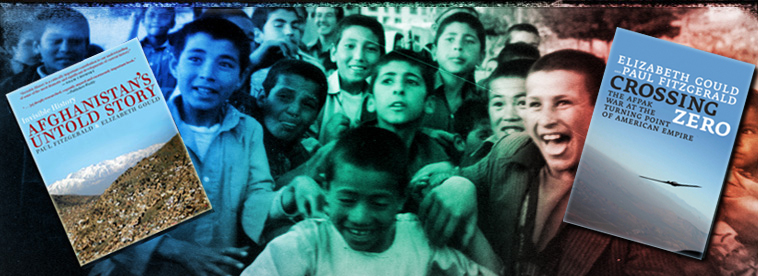
Crossing Zero: The AfPak War at the Turning Point of American Empire by Elizabeth Gould & Paul Fitzgerald
Things have not gone well for the NATO occupation since the publication in 2009 of Invisible Afghanistan by wife-and-husband journalist team Gould and Fitzgerald. Drones are now crossing “zero” (intel speak for the Durand line) every few days, and there has been progress on construction of some massive military bases the U.S. is hinting to be invited to help operate with the Afghan military, but little else. The death of Osama bin Laden was largely symbolic, and insurgency rages on. Maybe President Obama should have checked out Invisible‘s final chapter containing practical suggestions such as #4: Start helping Afghans in a way they can understand, see, and appreciate. Instead, three more years of occupation have produced a country where ¾ of people lack access to clean water, and one in five children dies before reaching adulthood, mostly due to water-borne diseases. Kabul, the capital, still has no sewer system, so pollution seeps into the water pumped from wells.
In their latest book Crossing Zero: The AfPak War at the Turning Point of American Empire, Gould and Fitzgerald not only present the NATO nation-building project as failed, but they join a growing of chorus of voices reporting that the effort to subdue insurgency in the region is rapidly losing ground. Their explanation of why this might be so focuses primarily two factors: the role of Pakistan, and the Pasthun tribe straddling the Durand Line. They also hint at a third factor rising: the U.S. may simply run out of money to continue.
Students of history will remember that Brittania drew a boundary west of which they ceded influence to Russia in the so-called Great Game. The boundary landlocked Afghanistan by keeping the port of Karachi in British imperial India, and split the Pashtun homeland. Pakistan fell heir to these territories when it was partitioned from newly independent India after WWII.
Our own country’s love-hate relationship with Pakistan is neatly summed up by the U.S. record of alternately bestowing and withdrawing military aid eight or nine times over the last twenty years. The authors discuss how the U.S. looked the other way at crucial junctures in Pakistan acquisition of nuclear weapons capability. They offer some gritty detail about what is now general knowledge: that Pakistan’s intelligence agency ISI trains, equips and otherwise supports fighters who attack NATO forces with regularity. Subsequent to the book’s publication the trend has continued, with Taliban spokesmen claiming responsibility for downing a NATO helicopter full of Navy SEALS, and for deploying suicide bombers to the Afghan governor’s office in Parwan, a usually quiet area north of the capital, and home to the immense Bagram Air Base.
If you are like me, you wonder why the U.S. pays billions each year in aid to a regime that funds and trains the insurgents who fight it. Besides providing a pretext for endless war, that is. Claims by their congressional enablers that Pakistan’s cooperation is key in the war on terror fall on increasingly deaf ears, especially as many citizens in the U.S. believe Osama bin Laden lived in Pakistan unmolested for years.
As for Pakistan’s motives, Gould and Fitzgerald make a convincing case that the regime in Pakistan fears it will be made redundant if NATO succeeds in pacifying Afghanistan. As long as war against militant elements persists, NATO needs the cooperation of Pakistan – for fuel transport, among other logistics. Arch enemy India might become an even better friend of the U.S., and Pakistan’s fate would be uncertain, especially in light of historic aspirations by Pasthuns to establish a nation of their own.\
The increasing influence of CIA drone strikes in the region is also noted. These have accelerated rapidly on President Obama’s watch, and recently an independent research team in the U.K found 168 children have been killed by bombs dropped from remote controlled drones since 2004. Gould and Fitzgerald remain unconvinced that the war for Afghan (and/or Pashtun) hearts and minds can be won in this fashion. And they speculate on the effect of discrediting the current government and driving Pakistan’s nuclear-capable military establishment into the arms of fundamental Islamist extremists such as the Pakistani Taliban who have vowed to remove the “infidels” running Pakistan.
Drones are crossing “zero” to bomb Pakistan’s tribal areas weekly, and the authors see this as a probable location where the American Empire passed the zenith of its imperial overreach. We now begin our descent, into a period of declining influence and strength worldwide, falling into the trap laid thirty years ago by funding mujahadeen homefield advantage fighters against the Soviets. The authors note the emergence of a new generation of insurgent leaders on both sides of the zero line that are more urban and tech savvy. If the 21st century version of the Great Game means countering the influence of the rising economic power of China, they see draining the U.S. treasury to fight the very terrorists our policies create offering little hope for a “win” on the playing field AfPak.
Lisa Savage
CODEPINK Maine Local Coordinator
☮☮Bring Our War $$ Home☮☮
Went 2 the Bridge blog
Part 1: 9/11, Psychological Warfare & the American Narrative
A Campaign Where the Lie Became the Truth and the Truth Became the Enemy of the State
By Elizabeth Gould & Paul Fitzgerald
 9/11. The number still rings in the mind as if chosen to act as a Pavlovian trigger: Outrage, anger, paranoia, retribution. A shadowy band of religious zealots fly not one, but two commercial airliners into the heart of America’s financial community while others deal a deadly blow to the Pentagon. It was a Hollywood movie, an act of war rivaling Pearl Harbor. Why did it happen? Who would do this to Americans, to America? How could a band of ragged terrorists plotting from a cave in faraway Afghanistan have accomplished such a complex task given the size and pervasiveness of the largest and most expensive military/intelligence apparatus in the history of the world? And even more curiously, why would Islamic radicals give the ideology-driven neoconservative administration of George W. Bush exactly the pretext they needed to launch a bloody invasion and further occupation of the Middle East?
According to the official narrative, 9/11 was an attack on everything American and in so doing changed everything about America. Like Kafkaesque characters who’d suddenly found themselves on the other side of a Cold War “Iron Curtain” mirror, Americans would now have to “watch what they say and watch what they do,” open up to questioning or face jail when prodded by squinty-eyed border guards and forsake any hope of privacy or dignity in a new world of electronic spies and full body scans. Former National Security Advisor, Admiral John Poindexter’s Total Information Awareness program would be enacted and a preexisting “Patriot Act” would be signed into law to clamp down on dissent and real or imagined domestic terrorism.
Some careful observers like Anthony Lewis of the New York Times had already noticed the bizarre coup-like changes coming over Washington in the months leading up to the attack as the George W. Bush administration inaugurated radical shifts in domestic and foreign policy that seemed un-American and alien to anything that had gone before. But those concerns would soon be forgotten in the race for revenge.
9/11 would ultimately give President George W. Bush and his neoconservative advisors all the public approval they needed to transform America and invade Afghanistan and Iraq to cleanse the world of evil in an endless “war on terror.” In the end it would turn America’s reputation for racial and religious tolerance, military invincibility and economic dominance on its head.
Looking back on the carnage of the last ten years it’s easy to see how the psychology of 9/11 changed America. What’s not easy to see is how a long standing campaign of covert psychological warfare built up since the early days of World War II had made the slow destruction of American democracy and the ascension of rule by secrecy inevitable, long before the planes ever left the runway on 9/11:
“If you tell a lie big enough and keep repeating it, people will eventually come to believe it. The lie can be maintained only for such time as the State can shield the people from the political, economic and/or military consequences of the lie. It thus becomes vitally important for the State to use all of its powers to repress dissent, for the truth is the mortal enemy of the lie, and thus by extension, the truth is the greatest enemy of the State.” –Dr. Joseph Goebbels
As chief propagandist for the Nazi Party, Joseph Goebbels system of black propaganda not only helped Hitler’s rise to power but kept him there by utilizing near-hypnotic powers over the German people even after the consequences of his disastrous failures had become obvious.
 To counter Goebbels’ propaganda theatre emanating from Nazi party headquarters at Munich’s Braunes Haus (Brown House), an organization named Freedom House was founded in New York City in 1941. Fronted by American celebrities and public luminaries such as Eleanor Roosevelt, the brains behind the outfit was Leo Cherne, the psychological warfare specialist/co-founder of the Research Institute of America (RIA), which would much later be labeled the “CIA for businessmen.”
If anyone was a match for Goebbels mastery of the black arts of psychological warfare it was Cherne. In 1938 Cherne had published a guide to industrial mobilization in Adjusting Your Business to War, prophetically forecasting the outbreak of war in Europe in 1939 and on September 1st of that year completed a 3000-page report titled, Industrial Mobilization Plans for World War II, the very day that German troops crossed into Poland.
That same year Cherne asked a young protégé named William J. Casey, the future director of the CIA, “How do you take a country like ours, stuck in depression, and convert it into an arsenal?” Their combined answer was the loose-leaf book called The War Coordinator. Cherne and Casey’s psychological warfare campaign would establish a narrative that didn’t just embrace freedom as its major theme, in their minds their ideas would actually become Freedom and through the use of propaganda would grow and harden over the decades into an impenetrable shield-like narrative of American triumphalism.
Cherne’s prophecies on war and business attained a near mystical quality and over the decades following World War II he would attract the most powerful and influential figures in American business and politics to his causes. A listing of Freedom House trustees on its 50th anniversary in 1991 includes people as diverse as Kenneth L. Adelman, Andrew Young, Zbigniew Brzezinski, Jeane J. Kirkpatrick, Albert Shanker, Donald Rumsfeld and James Woolsey. It has since become an exclusive neoconservative bastion.
 Freedom House’s narrative is no less than the narrative of the American century where, “It has fought on the side of freedom and against aggressors in struggles that can be evoked by simple words and phrases: the Marshall Plan, the Truman Doctrine, NATO, Hungarian Freedom Fighters, the Berlin Wall, the Prague Spring…” and of course Afghanistan.
We experienced Freedom House’s simple words and phrases and their dark influence on the major media in the spring of 1983 in a televised Nightline program following a trip to Afghanistan with Harvard Negotiation Project Director, Roger Fisher. We had brought Fisher to Afghanistan to explore the possibilities of a Soviet withdrawal of forces and discovered the Soviets were desperate to get out. But instead of expanding on Fisher’s efforts to get the Soviets out of Afghanistan, host Ted Koppel undermined the very premise of the discussion by introducing a political officer of the Jamaat-i Islami, which Koppel described as “an anti-communist resistance group based in Pakistan. He is here in the United States under the auspices of two American organizations, concerned with democracy in Afghanistan, the Afghan Relief Committee and Freedom House.”
Had Koppel and Freedom House really been concerned about democracy in Afghanistan, their choice of the Jamaat-i Islami could not be viewed as anything but the darkest of black propaganda, an outright lie.
Originally founded by the Pakistani theologian Abul Ala Maudidi in 1941, the goal of the Jamaat-i Islami was more than just that of gaining political representation for radical Islamists. The Jamaat was to be an all-embracing, extremist Islamic Society, crafted through the strictest interpretation of Islamic law, as a replacement for a modern western-style democracy.
Through the help of the mainstream media during the 1980s the psychological war promoted by Freedom House and Ronald Reagan’s C.I.A. director William J. Casey held the Soviets in Afghanistan for an additional six years, destabilized Central Asia, encouraged the growth of the largest heroin operation in history and enabled the rise of the very Islamic extremists that allegedly planned and carried off the attacks on 9/11.
Ten years after 9/11 Afghanistan remains the center of a growing Islamic insurgency and the longest war in American history. The success of America’s seventy year old psychological warfare campaign, where the lie became the truth and the truth became the enemy of the state, has now so disorientated America’s institutional thinking that we have reached the moment when the state can no longer shield the American people from the consequences of that lie. Copyright © 2011 Gould & Fitzgerald All rights reserved
Join with us on Friday, September 30th from 3-5:00 pm
A “Moment” of reflection for Hamid & Ahmed Wali Karzai
by Paul Fitzgerald & Elizabeth Gould
“The Diem Moment” for Karzai Brothers?
And so the notorious Ahmed Wali Karzai (A.W.K) is dead, killed by a (formerly) trusted bodyguard who had worked closely with U.S. Special forces and the C.I.A. The assassination of a C.I.A. strategic asset, alleged Kandahar drug boss and tribal “fixer” for his half brother Afghan president Hamid Karzai raises a lot of questions, not to mention issues, about the nature as well as the future of America’s involvement in Afghanistan.
Not surprisingly, the Taliban issued a statement claiming credit for the killing as retribution for his role in “Cooperating with the Americans, Canadians and Britons… for spreading the net of intelligence of the Western invaders and boosting their sway in south-west Afghanistan.” They also claimed he continued to receive “high salary from CIA.”
As it was elsewhere in Afghanistan, America’s approach to Kandahar after 2001 was always counterintuitive. Putting hated warlords back in charge to fill the leadership vacuum left by fleeing Taliban was expedient but self-defeating. But U.S. reliance on this unorthodox strategy for success has remained consistently curious for the Taliban-stronghold. During a trip to Kabul in the fall of 2002 we were told that Pakistani ISI were crossing the Durand line (the disputed border between Afghanistan and Pakistan) to openly recruit Afghans for al Qaeda/Taliban cells in the villages of the province. No one we spoke to could explain such a lapse in U.S. intelligence, considering that at the time, (prior to the Iraq invasion) the U.S. had all the resources necessary to deal with such a flagrant cross-border operation.
In the ensuing years, Ahmed Wali Karzai filled in for the U.S. absence by running Kandahar province as a Karzai family protectorate. With C.I.A. backing A.W.K. built his power base up from nothing and in 2005 was elected to Kandahar’s provincial council. With local officials and tribal elders in his pocket, he was a sure bet to take over the governor’s office. In 2008, A.W.K. ran afoul of his C.I.A. beneficiaries and was subjected to an intense effort by senior US military officials to remove him prior to the “surge” of U.S. forces. That effort failed, but the acrimony and distrust of Ahmed Wali’s methods and alliances remained.
As a linchpin in General Petraeus’s 2009 “surge” strategy for victory over the Taliban, A.W.K. symbolized the dysfunctional symbiosis stretching between the Presidential Palace, the American Command and the U.S. Embassy. His sudden absence now leaves either a strategic vacuum in U.S. plans or a long awaited opportunity – just as the promised U.S. draw down begins and Petraeus ends his Afghan tour to become the Director of Central Intelligence.
In September of 2010, former Chief of the C.I.A.’s Directorate of Operations, Dr. Charles Cogan invoked the ghost of Vietnam when he posted a blog asking whether the United States wasn’t approaching “the Diem Moment” in relation to Hamid Karzai and his powerful brothers. Vietnamese president Diem and his brother Nhu were perceived as having become anti-American and were making passes at France and even the enemy in Hanoi. Cogan suggested that the time was fast approaching for Mr. Karzai and his family members to be offered safe passage out of Afghanistan before the worst befell them.
But as Dr. Cogan should know, A.W.K’s assassination smacks of another event in Afghan history far more appropriate to this moment than allusions to Vietnam, and it’s that moment which we’ll call the “Hafizullah Amin moment” that better provides the clues to the strange death of Ahmed Wali Karzai.
Hafizullah Amin was the U.S. educated, pseudo-Marxist Afghan-nationalist-strongman overthrown by the Soviets that December 1979, after playing out his role in a tragicomic farce to lure the Soviets into their own Vietnam. It was well known at the time that Amin had a longstanding relationship with the C.I.A. and was cutting a deal (brokered by Pakistan) with his fellow Ghilzai Pashtun, Gulbuddin Hekmatyar. U.S. ambassador Adolph Dubs had been carefully trying to work Amin away from Soviet influence but was so worried about his provocative behavior Dubs had gone to his own C.I.A. station chief and demanded to know if Amin was a C.I.A. agent. In February of 1979, Dubs ran into the deeper agenda already underway when he was kidnapped by a band of Tajik Maoists and assassinated when Amin ordered an attack on the room where he was being held hostage.
In the months leading up to the Soviet invasion, Amin tried to twist out of the knot by filling Kabul’s ministries with his closest relatives, arresting scores of old friends and agreeing to accept the Durand line as the permanent border with Pakistan, but his time in the saddle had run out. Amin had become hated by his own people and a disposable nuisance to all concerned, both American and Soviet. The rest, as they say, is history.
Fast Forward to 2011 as a panicked President Hamid Karzai surrounds himself with relatives, anti-US advisors and religious fanatics drawn once again from the ranks of Gulbuddin Hekmatyar’s Hesb-i Islami, as he fends off hostile attacks and conspiracies from a dozen directions meant to bring him down.
With his power-broker-brother gone and his access to Kandahar’s complex patronage system cut off, Hamid Karzai has been dealt a severe blow. The death of Ahmed Wali Karzai closes off a major option for his half brother Hamid at a crucial moment when Washington has shifted into phase two of its ten year program for Central Asia and with the Durand line once again the focus of the U.S. war. Next up comes the large military bases that the U.S. wants to occupy beyond 2014 and a status of forces agreement. This is something which Karzai cannot afford to allow for fear of alienating Afghanistan’s population and his regional neighbors and at the same time cannot refuse and continue to accept protection as an American client. Karzai is desperate to find allies to save him, but time is short. Should he get the nod from strongman Gulbuddin Hekmatyar’s backers in Iran and Pakistan to merge his dwindling political forces with those of the Hesb-i Islami he may get a reprieve, but without his man in Kandahar, Ahmed Wali to do his dirty work, Hamid Karzai’s “Hafizullah Amin moment” may be right around the corner.
Copyright © 2011 Gould & Fitzgerald All rights reserved
THE HUFFINGTON POST
By Paul Fitzgerald and Elizabeth Gould
As the first journalists to enter Kabul in 1981 for CBS News with Dan Rather following the expulsion of the Western media the previous year, we continue to be amazed at how the American disinformation campaign between Hollywood, Washington and Wall Street built around the Soviet invasion of Afghanistan lives on. We’ve seen this pattern from the media again and again. It happened AGAIN in Huffpost’s July 8th 10 Jaw-Dropping Journalism Scandals that missed the biggest scandal of all.
| Watch our critique of the MSM “narrative” Exposing the Official 1980s – created to build support for Charlie Wilson’s War following the Soviet invasion of Afghanistan. Click here for the Mary Williams Walsh 1990 interview in The Progressive Magazine that lays out the charges of fakery against CBS News for its Afghanistan coverage. |
Our opportunity to see inside a Soviet-occupied Afghanistan revealed a complex story of political betrayal, women’s rights and a struggle for modernity, but the footage we returned with didn’t conform to the evil empire image that CBS News had been promoting. Four weeks after our return, a story about our trip was aired, cross-cut with footage created by the Soviets that in no way represented our experience. But as an anti-Soviet piece, it was masterful. Then in 1983, under contract to ABC Nightline, we invited Roger Fisher, director of the Harvard Negotiation Project, to return with us to assess the chances of negotiating the Soviets out of Afghanistan. Roger told us that the Kremlin’s chief Afghan specialist said, “Give us six months to save face and we’ll leave the Afghans to solve their own problems.” This information was rejected as news by ABC World News Tonight. Then the Soviet request – as explained by Roger on Nightline – was framed in such a way by host Ted Koppel, that it dispelled any notion that there was a chance of a Soviet withdrawal.
As the decade of the 1980s wore on, the Soviet occupation left the realm of journalism and transformed into a Ramboesque struggle of holy warriors against the evil empire. Then in 1989 when the Soviets withdraw, the Afghan story disappeared from the media’s radar completely. The cold war had ended and the mythology dictated that the U.S. had “won.” The Afghan people were left to deal with the blowback from the mujahideen fighters who had been supported by the largest publicly known U.S. covert operation since Vietnam. Over the next few years that process would give rise to the Taliban and morph into the threat the U.S. faces today. Without any serious reflection on the consequences of funding and training extremists for the purpose of defeating the Soviet Union, the American media not only missed the deeper story, but ignored where the Afghan story had been corrupted for political purposes.
Then articles in the New York Post by Janet Wilson in 1989 and a Columbia Jounalism Review article by Mary Williams Walsh in 1990 charged that CBS News repeatedly aired fake battle footage and false news accounts. The accusations caused no serious questioning by the media. It wasn’t until 9/11 that Afghanistan got back on the media’s radar. But the media continues to resist the deeper analysis necessary to bring about the kind of thinking required by America’s current intervention in Afghanistan.
To this day, the press largely accepted, without investigation, the view that a Soviet triggered Muslim Holy War against communism was taking place. Even when both Robert Gates, the former Secretary of Defense, and Zbigniew Brzezinski President Carter’s national security adviser, admitted in print (Gates, in his book, From the Shadows; Brzezinski, 1998 interview in Le Nouvel Observateur), that the U.S. had been secretly undermining its own diplomatic efforts in order to give the Soviets their own Vietnam in Afghanistan, the American press failed to see it as news.
Brzezinski’s Le Nouvel Observateur remarks are addressed in a 2005 interview he did with Samira Goetschel for her film, Our Own Private Bin Laden. She asked: “In your 1998 interview with the French Magazine Le Nouvel Observateur you said that you knowingly increased the probability of the Soviet invasion of Afghanistan.” Brzezinski responded: “The point very simply was this. We knew the Soviets were already conducting operations in Afghanistan. We knew there was opposition in Afghanistan to the progressive effort which had been made by the Soviets to take over. And we felt therefore it made a lot of sense to support those that were resisting. And we decided to do that. Of course this probably convinced the Soviets even more to do what they were planning to do…”
As we document in our books, the record contradicts Brzezinski’s assumption that the Soviets would have invaded. The world was remade with the Soviet folly in Afghanistan, a Communist empire destroyed and the West’s pre-eminence assured. But the price in human suffering in Afghanistan and the impact on our democratic freedoms and aggressive press coverage has yet to be understood.
Sibel Edmonds boilingfrogspost presents:
 Journalistic Jihad: Holes in the Coverage of a Holy War, by Erwin Knoll, 1990
Dr. Charles Cogan, ex CIA Director of Operations, South Asia comments on the accuracy of Gould & Fitzgerald’s
Dr Charles Cogan, ex CIA Director of Operations, South Asia comments on the accuracy of Gould & Fitzgerald’s presentation at 30:11 minutes.
Cambridge Forum says this about Gould & Fitzgerald:
When Americans needed to know accurately the complex history of Afghanistan, traced back over 10,000 years, why were we given exactly the opposite in incorrect, simplistic, pro US Cold War images in Dan Rather’s TV reports and the film, Charlie Wilson’s War? What should the US government have told citizens before 9/11, but instead, kept secret? How can President Obama create a new policy without repeating past mistakes of Britain, the USSR and the Bush Administration that builds lasting good will toward the US?
Widely considered America’s leading journalists interpreting Afghanistan, Paul Fitzgerald and Elizabeth Gould, a husband and wife team, were the first US television crew granted visas to enter Afghanistan in the spring of 1981. They arrived in the heated Cold War era, but the people they found did not fit the preconceived, stereotyped Cold War bias desired by their employer, CBS. In 1983, they produced a landmark PBS documentary, Afghanistan Between Three Worlds. In the 80s and 90s, they continued writing about Afghanistan: a script with Oliver Stone, reports for ABC’s Nightline and a book about human rights and women, Women for Afghan Women: Shattering Myths and Claiming the Future.
Host David Frenkel interviews Fitzgerald & Gould

Fitzgerald and Gould Examine the Afghan American Narrative
(pdf 1.01 MB)