
The tangled web leading up to Afghanistan
We made a documentary with economist John Kenneth Galbraith and Strategic Arms Limitation Talks (SALT II) negotiator Paul Warnke on the eve of the Soviet invasion of Afghanistan in 1979. Our timing with this issue made the Soviet invasion seem all too convenient. As we point out at the very end, it was President Carter who asked the Senate to hold back on ratification of SALT II following the invasion while having secretly authorized Brzezinski’s black project to lure the Soviets into Afghanistan in the first place. The Soviet invasion enabled the military/industrial/congressional complex to shift the political discussion permanently away from the civilian sector and towards the need for an unending military escalation of all sectors of the economy. It’s the basis of the false narrative of triumphalism our country is dying from today.
The Arms Race and the Economy: A Delicate Balance can be viewed here.
America’s Financial Armageddon and Afghanistan is an article we wrote that goes more deeply into the Cold War effects on today’s economy.
America’s Financial Armageddon and Afghanistan
by PAUL FITZGERALD and ELIZABETH GOULD
The U.S. economy grinds down to a finish, it becomes increasingly difficult to measure whether Washington understands the importance of how to deal realistically with the worsening crisis in Afghanistan. Left off the front pages during the recent obsession with the debt crisis, Afghanistan has lurched back onto the scene in ways that are reminiscent of the Soviet collapse of two decades ago. After ten years of war, it seems Washington not only continues to lack a comprehensive understanding of Afghanistan, but it lacks an understanding of its own role in creating both the economic and political catastrophe it now faces.
Even less understood is how the political decisions of the late 1970s are tied to the current simultaneous financial and foreign policy crisis. Nor is it understood how Washington and Wall Street set the stage for America’s financial downfall by using Afghanistan as an investment bank throughout the 1980s to renew the Cold War instead of reinvesting in America’s civilian economy.
Much like today, the America of 1979 faced a crossroads. Vietnam, two oil shocks, a disintegrating infrastructure, a beleaguered manufacturing base and the loss of strategic ally Iran had shown that America was a vulnerable colossus. Thirty five years of economic Cold War against the Soviet Union and China had produced a vast arsenal of nuclear weapons that were proving as useless as they were unusable. World War II had set the stage for the happy marriage of war production to business — pulling the U.S. out of the depression by doubling the Gross National Product in one year (1940). The Cold War ushered the financial benefits of the 1940s into the 1950s and 1960s. But these expenditures came at a massive expense to the civilian economy and not just in terms of tax dollars. Weapons development of the post World War II years lured America’s best and brightest away from the civilian economy and even the real world of guns, tanks and armies into a world detached from time, space and money. While Germany and Japan rebuilt their civilian industries free from defense spending, the U.S. moved into ever higher levels of technology, glorifying and expanding the influence of the defense industry into every fabric of American life.
Originally termed Military Keynesianism to describe the buildup of the German defense industry prior to World War II, America’s military Keynesianism of the Cold War was the unseen hand of government supporting the American economy, balancing the cyclical ups and downs of the market by providing 16 percent of the Gross Domestic Product in 1950s and 9 percent in the 1960s. By 1963 defense spending accounted for 52 percent of all the research and development done in the United States. But by the mid-1970s, a stagnant American economy combined with the Arab oil embargo and inflation brought on by the Vietnam War exposed the weakness in the system. As German and Japanese manufacturers battered their American competition in the marketplace, the defense-heavy American economy faltered.
Born of necessity, diplomatic overtures to China and détente with the Soviets offered the first chance since World War II to get off the wartime treadmill. To that end, for most of the decade the U.S. and Soviet Union pursued Strategic Arms Limitation Talks.
Endorsed by President Nixon in 1972, it was hoped that the agreement signed by President Carter and General Secretary of the Communist Party of the Soviet Union Leonid Brezhnev would enable the United States to back away from weapons manufacturing and reinvest those resources in the civilian economy. But the Soviet invasion of Afghanistan changed all that.
Our involvement in this story began in the summer of 1979 when we began production of a documentary we called Arms Race and the Economy: A Delicate Balance. During the next months numerous experts including economist John Kenneth Galbraith lent their experience to our understanding of the unseen damage that a massive new diversion of tax dollars and capital investment would represent to the civilian economy. The arms race wasn’t just about defending the United States. The arms race was also about jobs and money in a dark world of business, science, and politics ruled over by a self-described “priesthood” of experts. Galbraith insisted that accelerated defense spending and renewing the Cold War, which the neoconservative right was lobbying hard for at the time, would ultimately destroy the civilian economy. He was convinced that the Cold War had already helped rigidify the capitalist system by bureaucratizing a large part of production for non-productive uses. He saw American industry becoming more and more like the Soviet Union, ruled by a military-industrial-academic establishment immune from reality, living in a planned economy designed to suit its own needs at the expense of society.
Galbraith jokingly referred to his “First Law of Executive Talent” that he had formulated to describe the thinking of America’s military-industrial leadership. “It was that all great executives come to resemble intellectually the products they manufacture. Until you had done business with top officers of the steel industry, you didn’t really appreciate the intellectual qualities of a billet of steel.” So it was with the defense department. America’s militarized economy was already in essence a Soviet-style “planned economy,” to make it an even larger part of the economy would only lock the U.S. into the same dismal fate.
That fall, in Washington, the Arms Control and Disarmament Agency was one of the last holdouts of sanity in a rolling sea of hysterical accusations about American security. Was the Soviet Union really planning a sneak attack on the United States with nuclear weapons as the right wing claimed? Was SALT II really just a public relations scheme by Moscow to put the U.S. off its guard?
In hindsight we know that these claims were absurd. The Soviet Union was dying, driven to SALT by its weakness, not its strength. But when the Soviets crossed their southern border into Afghanistan that December of 1979 it played out on America’s TV screens like a World War II Hollywood B movie. Afghanistan was a far off South Asian country of no particular interest to the United States. A half dozen administrations had refused Afghan requests for military assistance. Eisenhower’s Secretary of State John Foster Dulles’s callous and careless diplomacy drove Afghanistan towards Moscow in the mid 1950s and its politics followed close behind. A low priority remnant from Britain’s colonial empire, President Carter labeled the invasion, “the greatest threat to peace since the second World War.” But the script had already been written long before the Soviet’s crossed their southern border on December 27, 1979.
A trap had been set to give the Soviets their own Vietnam and the Soviets had taken the bait. But no one outside a handful of policy experts and Wall Street wizards were supposed to know that. Instead, a crop of neoconservative experts appeared on the scene claiming the Soviets were running out of oil and using Afghanistan as a staging ground for Middle East conquest.
By the time our program aired that winter, the argument was no longer whether our government should call a halt to the nuclear arms race and reinvest in the civilian economy. The U.S. had stepped into the mirror with the media echoing a return to 1947 style Cold War rhetoric, and the debate refocused not on whether, but on how much was to be spent to counter Soviet aggression.
In the planning stages for most of the decade, the new right’s military stimulus program regained for them a strategic hold over the economy, raising American investment in new weapons systems to a new high, while setting in motion a series of changes to the fundamental economic order endemic to the previous iteration of the Cold War.
As it had in the 1950s and 1960s, military spending once again drove the American economy, accounting for up to 6.2 percent of GDP by 1984. But where previous defense spending had been carefully balanced against America’s industrial output as a percentage of GNP, the so-called Reagan agenda or Reaganomics required massive borrowing to finance the military budget while reducing regulation and oversight of where it was spent. This change would transform American thinking about the economy, sending it into a star wars unreality and more importantly from a creditor to a debtor economy.
Always detached from the real economy, the Reagan budgets lifted the arms race and its Wall Street backers into the stratosphere, focusing the nation’s attention away from the depression era roads, bridges, dams, schools and industry that were in desperate need of attention. Instead, America became transfixed by the phantom of an ever present danger of Soviet troops in Afghanistan and a stock market driven by the military’s expansion.
Part I – 9/11, Psychological Warfare and the American Narrative Series
A Campaign Where the Lie Became the Truth and the Truth Became the Enemy of the State
By Elizabeth Gould & Paul Fitzgerald
 9/11. The number still rings in the mind as if chosen to act as a Pavlovian trigger: Outrage, anger, paranoia, retribution. A shadowy band of religious zealots fly not one, but two commercial airliners into the heart of America’s financial community while others deal a deadly blow to the Pentagon. It was a Hollywood movie, an act of war rivaling Pearl Harbor. Why did it happen? Who would do this to Americans, to America? How could a band of ragged terrorists plotting from a cave in faraway Afghanistan have accomplished such a complex task given the size and pervasiveness of the largest and most expensive military/intelligence apparatus in the history of the world? And even more curiously, why would Islamic radicals give the ideology-driven neoconservative administration of George W. Bush exactly the pretext they needed to launch a bloody invasion and further occupation of the Middle East?
According to the official narrative, 9/11 was an attack on everything American and in so doing changed everything about America. Like Kafkaesque characters who’d suddenly found themselves on the other side of a Cold War “Iron Curtain” mirror, Americans would now have to “watch what they say and watch what they do,” open up to questioning or face jail when prodded by squinty-eyed border guards and forsake any hope of privacy or dignity in a new world of electronic spies and full body scans. Former National Security Advisor, Admiral John Poindexter’s Total Information Awareness program would be enacted and a preexisting “Patriot Act” would be signed into law to clamp down on dissent and real or imagined domestic terrorism.
Some careful observers like Anthony Lewis of the New York Times had already noticed the bizarre coup-like changes coming over Washington in the months leading up to the attack as the George W. Bush administration inaugurated radical shifts in domestic and foreign policy that seemed un-American and alien to anything that had gone before. But those concerns would soon be forgotten in the race for revenge.
9/11 would ultimately give President George W. Bush and his neoconservative advisors all the public approval they needed to transform America and invade Afghanistan and Iraq to cleanse the world of evil in an endless “war on terror.” In the end it would turn America’s reputation for racial and religious tolerance, military invincibility and economic dominance on its head.
Looking back on the carnage of the last ten years it’s easy to see how the psychology of 9/11 changed America. What’s not easy to see is how a long standing campaign of covert psychological warfare built up since the early days of World War II had made the slow destruction of American democracy and the ascension of rule by secrecy inevitable, long before the planes ever left the runway on 9/11:
“If you tell a lie big enough and keep repeating it, people will eventually come to believe it. The lie can be maintained only for such time as the State can shield the people from the political, economic and/or military consequences of the lie. It thus becomes vitally important for the State to use all of its powers to repress dissent, for the truth is the mortal enemy of the lie, and thus by extension, the truth is the greatest enemy of the State.” –Dr. Joseph Goebbels
As chief propagandist for the Nazi Party, Joseph Goebbels system of black propaganda not only helped Hitler’s rise to power but kept him there by utilizing near-hypnotic powers over the German people even after the consequences of his disastrous failures had become obvious.
 To counter Goebbels’ propaganda theatre emanating from Nazi party headquarters at Munich’s Braunes Haus (Brown House), an organization named Freedom House was founded in New York City in 1941. Fronted by American celebrities and public luminaries such as Eleanor Roosevelt, the brains behind the outfit was Leo Cherne, the psychological warfare specialist/co-founder of the Research Institute of America (RIA), which would much later be labeled the “CIA for businessmen.”
If anyone was a match for Goebbels mastery of the black arts of psychological warfare it was Cherne. In 1938 Cherne had published a guide to industrial mobilization in Adjusting Your Business to War, prophetically forecasting the outbreak of war in Europe in 1939 and on September 1st of that year completed a 3000-page report titled, Industrial Mobilization Plans for World War II, the very day that German troops crossed into Poland.
That same year Cherne asked a young protégé named William J. Casey, the future director of the CIA, “How do you take a country like ours, stuck in depression, and convert it into an arsenal?” Their combined answer was the loose-leaf book called The War Coordinator. Cherne and Casey’s psychological warfare campaign would establish a narrative that didn’t just embrace freedom as its major theme, in their minds their ideas would actually become Freedom and through the use of propaganda would grow and harden over the decades into an impenetrable shield-like narrative of American triumphalism.
Cherne’s prophecies on war and business attained a near mystical quality and over the decades following World War II he would attract the most powerful and influential figures in American business and politics to his causes. A listing of Freedom House trustees on its 50th anniversary in 1991 includes people as diverse as Kenneth L. Adelman, Andrew Young, Zbigniew Brzezinski, Jeane J. Kirkpatrick, Albert Shanker, Donald Rumsfeld and James Woolsey. It has since become an exclusive neoconservative bastion.
 Freedom House’s narrative is no less than the narrative of the American century where, “It has fought on the side of freedom and against aggressors in struggles that can be evoked by simple words and phrases: the Marshall Plan, the Truman Doctrine, NATO, Hungarian Freedom Fighters, the Berlin Wall, the Prague Spring…” and of course Afghanistan.
We experienced Freedom House’s simple words and phrases and their dark influence on the major media in the spring of 1983 in a televised Nightline program following a trip to Afghanistan with Harvard Negotiation Project Director, Roger Fisher. We had brought Fisher to Afghanistan to explore the possibilities of a Soviet withdrawal of forces and discovered the Soviets were desperate to get out. But instead of expanding on Fisher’s efforts to get the Soviets out of Afghanistan, host Ted Koppel undermined the very premise of the discussion by introducing a political officer of the Jamaat-i Islami, which Koppel described as “an anti-communist resistance group based in Pakistan. He is here in the United States under the auspices of two American organizations, concerned with democracy in Afghanistan, the Afghan Relief Committee and Freedom House.”
Had Koppel and Freedom House really been concerned about democracy in Afghanistan, their choice of the Jamaat-i Islami could not be viewed as anything but the darkest of black propaganda, an outright lie.
Originally founded by the Pakistani theologian Abul Ala Maudidi in 1941, the goal of the Jamaat-i Islami was more than just that of gaining political representation for radical Islamists. The Jamaat was to be an all-embracing, extremist Islamic Society, crafted through the strictest interpretation of Islamic law, as a replacement for a modern western-style democracy.
Through the help of the mainstream media during the 1980s the psychological war promoted by Freedom House and Ronald Reagan’s C.I.A. director William J. Casey held the Soviets in Afghanistan for an additional six years, destabilized Central Asia, encouraged the growth of the largest heroin operation in history and enabled the rise of the very Islamic extremists that allegedly planned and carried off the attacks on 9/11.
Ten years after 9/11 Afghanistan remains the center of a growing Islamic insurgency and the longest war in American history. The success of America’s seventy year old psychological warfare campaign, where the lie became the truth and the truth became the enemy of the state, has now so disorientated America’s institutional thinking that we have reached the moment when the state can no longer shield the American people from the consequences of that lie.
Part II Building the Afghan Narrative with Black Propaganda, the People, the Process & the Product
Part III A Clockwork Afghanistan
Copyright © 2011 Gould & Fitzgerald All rights reserved
Part I: House of Mirrors Series
Mystical Covert Agendas
America’s New Role as the Dark Force
By Elizabeth Gould & Paul Fitzgerald
As the U.S. becomes more and more the kind of country it has traditionally opposed, the answer to where we are headed may lie more in the arcane traditions of a dim past than in a bright future.
“‘We’re the dark matter. We’re the force that orders the universe but can’t be seen,’ a strapping Navy SEAL, speaking on condition of anonymity, said in describing his unit.”
If anyone (correctly) thought that the war on terror and Washington’s response to it had taken on a fantastical otherworldly quality, this recent quote on the front page of the Washington Post seemed to confirm it.
Following 9/11 the elected government of the United States of America delivered the country to a whole department (of Homeland Security) dedicated to expanding the government’s fear of darkness into everybody’s life (remember the 2003 duct tape and plastic sheeting craze?) Now we also have a top secret military operation known as the Joint Special Operations Command (JSOC) that thinks it is the dark.
Begun as a modest hostage rescue team, JSOC has morphed into a veritable heart of darkness, with the power to murder at will and with immunity from American legal jurisdiction (which apparently still maintains that such assassinations are illegal).
Even within the military, JSOC operates as a “Stovepipe,” operation, meaning that it operates completely in the black, reports to no one and continues to employ rogue ex-CIA professionals such as indicted Iran Contra operative Dewey Clarridge. The Navy Seal Team that took out Osama bin Laden operated under JSOC. Retired military personnel refer to JSOC as “Murder, Incorporated” and the “most dangerous people on the face of the earth.”
But if JSOC’s reputation for secrecy, vengeance and death from above can’t be explained from within the context of traditional U.S. military operations or U.S. law, then what set of rules is it operating from? Or is it simply that the traditions of rationalism and law that most Americans took for granted about the United States are subject to deeper, religious, or perhaps even mystical rules, whose anachronistic logic has found a renewed acceptance in an irrational world of personal, private and holy war?
No one less than the legendary Cold Warrior, Time Magazine’s Henry Luce understood that his passion for defeating Communism constituted “a declaration of private war,” which, in citing the example of the privateer Sir Francis Drake made it not only “unlawful,” but “probably mad.” As the child of American missionaries, Luce was committed to the militant spread of Christian Capitalism while viewing its ultimate triumph over the world as an inevitable consequence of God’s will.
Known to its 19th century advocates as mystical imperialism, the term can be traced to both Britain and Russia’s 19th century efforts to establish dominion through a mix of imperialism and Christian zeal. The competition came to a dead stop in Afghanistan with the end of the Great Game in 1907. The Bolshevik Revolution of 1917 complicated matters by infusing a heavy dose of socialist realism. But with the advent of the Cold War and the mysterious and intoxicating god-like qualities inherent in nuclear weapons, a new iteration of mystical imperialism came into being.
America’s mystical Cold War warriors were far removed technologically from their 19th century counterparts whose Christian elite believed they were bringing rational western thinking to the “darker regions of the earth.”
The sole purpose of America’s mid 20th century defense intellectuals was to rationalize nuclear war scientifically. Their failure over time ultimately dragged an entire stratum of American scientific and political thought back into the irrational realm of medieval mysticism. A 1960s London Times Literary Supplement marveled at the new priesthood who moved as freely through the corridors of the Pentagon and the State Department as the Jesuits once had through the courts of Madrid and Vienna, centuries before. Tasked with defeating Communism they invented their own reality, accelerated the nuclear arms race, created the domino theory of Communist expansion and then escalated the war in Vietnam to counter it.
President Kennedy’s science advisor Jerome Wiesner eventually came to realize that the so called “missile gap” and the massive buildup of America’s nuclear arsenal in response to it was only a “mirror image” of America’s own intentions towards the Soviet Union and not the other way around. Yet instead of addressing the error, the U.S. slipped deeper into the Cold War mirror until its own identity began to take on the image of its “Other.”
By 1973 these thermonuclear Jesuits and their CIA counterparts were using the U.S., NATO, China, Iran and Saudi Arabia to shake the Soviet Union’s domination over Central Asia through a Christian/Islamic holy war in Afghanistan. In a rational world it might be assumed that this war was supposed to stop with the defeat of the Soviet Union and the collapse of Communism. But instead of ending, America’s full blown splurge into personal and private holy war had caused the U.S. to slip into a crisis of identity.
Forced after seventy five years of anti-communism to finally define itself based on what it stood for and not what it stood against, the United States entered a house of mirrors in which it continues to wander. Stricken by the results of decades of economic and military excess, it finds its mission confused and its underlying philosophical grounding threatened.
What is America on the eve of 2012? Who are these Americans who revel in their dark powers? What have we become and how did we get that way?
Join us as we explore the little-analyzed facts and mystical covert agendas that the United States continues to press on with into the 21st century and what those agendas may mean to America’s new role as the dark force that orders the universe in the run up to the 2012 presidential elections.
Part III– Making the Irrational Rational by turning the Empirical into the Lie & the Fantasy into the Truth
Copyright © 2011 Gould & Fitzgerald All rights reserved
Published on Boiling Frogs Post
Pashtun Awakening: Defeat the Taliban by Changing the Narrative
The Afghan think tank we collaborate with, New World Strategies Coalition, has released an important policy brief. Pashtun Awakening: Defeat the Taliban by Changing the Narrative outlines a solution for the disintegrating situation in Afghanistan that can work for all the Afghan people. ======================================================================================= FOR IMMEDIATE RELEASE
Afghanistan Policy Brief
From: New World Strategies Coalition (NWSC) Media inquiries: khalil.nouri@nwscine.org
PASHTUN AWAKENING: DEFEAT THE TALIBAN BY CHANGING THE NARRATIVE
WASHINGTON, D.C. – The New World Strategies Coalition, a think tank founded by native Afghans which creates nonmilitary solutions for Afghanistan, released its latest policy brief today entitled, Pashtun Awakening: Defeat the Taliban by Changing the Narrative.
The policy brief outlines a solution for resolving the situation in Afghanistan by exposing how Pakistan has systemically weakened Afghanistan’s sacred tribal structure via its Taliban proxy. Pakistan and the Taliban have conspired to keep the Pashtuns, the country’s largest ethnic group, in the dark ages in order to advance Islamabad’s age-old agenda of controlling Kabul, by replacing the Afghan ancient tribal code with the extremist ideology of the Taliban – a process we refer to as “de-Pashtunization.”
The objective of this brief is to provide U.S. policymakers with a snapshot of the ground truth in Afghanistan so they can make informed decisions on how to best address the de-Pashtunization of Afghan society. The key to setting the Afghans free is by setting the truth free, as the brief explains:
There is still hope if the Pashtuns can restore their sacred tribal structure and identify the Taliban movement for what it really is – a religious mafia concocted on white boards in Rawalpindi.
In order to accomplish this, NATO and ISAF should focus on unifying the Pashtuns through a grassroots information campaign – a path that will be much more effective than the military option:
If the crux of the problem is a lost narrative the solution is taking it back from the jihadists who hijacked it. This calls for identifying, confronting and defeating propaganda through public diplomacy counterstrikes and preemptive psychological tactics.
The Policy Brief can be downloaded by clicking here.
The Arms Race and the Economy: A Delicate Balance
The tangled web leading up to Afghanistan
We made a documentary with economist John Kenneth Galbraith and Strategic Arms Limitation Talks (SALT II) negotiator Paul Warnke on the eve of the Soviet invasion of Afghanistan in 1979. Our timing with this issue made the Soviet invasion seem all too convenient. As we point out at the very end, it was President Carter who asked the Senate to hold back on ratification of SALT II following the invasion while having secretly authorized Brzezinski’s black project to lure the Soviets into Afghanistan in the first place. The Soviet invasion enabled the military/industrial/congressional complex to shift the political discussion permanently away from the civilian sector and towards the need for an unending military escalation of all sectors of the economy. It’s the basis of the false narrative of triumphalism our country is dying from today.
The Arms Race and the Economy: A Delicate Balance can be viewed here. We included America’s Financial Armageddon and Afghanistan, an article we posted last September that goes more deeply into the Cold War effects on today’s economy is available online here.
Crossing Zero: The History of The Durand Line
Here is a link to a 53 minute program we created titled, Crossing Zero: The History of The Durand Line
About this episode
Two ‘mad scientists’ create sleep mask that lets people CONTROL their dreams
Afghanistan bedeviled by ‘Mystical Imperialism’
A review by Michael Hughes May 1, 2012 Examiner.com article
Gould and Fitzgerald’s books on Afghanistan, Invisible History and Crossing Zero, have won praise from the likes of Noam Chomsky, Oliver Stone and Daniel Ellsberg. They were also the first Western journalists allowed back into Soviet-occupied Afghanistan during the early 1980s, when Paul discovered a story that wasn’t being reported in the mainstream press.
While conducting research for their books, Paul and Liz discovered a trove of esoteric history surrounding the West’s attraction to Afghanistan, dating back to the 1800s when the British set out to colonize the non-Christian world. During the lecture, Liz provided this brief explanation of an age-old esoteric ideology which continues to infect our current political and military leaders:
“Simply put, Mystical imperialism rationalizes the expansion of a nation’s authority, by conquest over other nations, by infusing a sense of the divine into the raw politics of empire building. Today’s practitioners of American Mystical Imperialism are a hardened core of ideological defense intellectuals and military officers who infuse their own esoteric and religious beliefs into Washington policymaking.”
Mystical imperialism can be traced back about 400 years to the British East India Company’s draconian pursuit of profits at any cost, as the Russians were demonized to protect the Raj’s interests in Central Asia and India. Somewhere along the line the British convinced themselves and the world that Russia was bent on controlling routes to the Persian Gulf – a neurosis that forced the British to do everything in its power to transform Afghanistan into a protective bulwark against Czarist Russia’s inevitable expansion.
This type of thinking was then embraced by the U.S. at the dawn of the Cold War. In the 1970s American policymakers and the media came to view the struggle in Afghanistan through a Manichean prism, and the Soviets were on the wrong side of this black and white world which saw the U.S. find common cause with violent Islamist fanatics, purportedly to ensure Afghanistan remained a Cold War “buffer zone.”
The blinding Cold War paradigm became like a religion, bemoaned by Senator William Fulbright as early as 1972: “Our ‘faith’ liberated us, like the believers of old, from the requirements of empirical thinking… Like medieval theologians, we had a philosophy that explained everything to us in advance, and everything that did not fit could be readily identified as a fraud or a lie or an illusion.”
Even when the U.S. had an opportunity to detangle itself from Afghanistan it resisted. In fact, the U.S. aimed to draw the Soviets into Afghanistan in what later became known as the “Bear Trap”, designed by Zbigniew Brzezinski to give communist Russia its own Vietnam War.
An underreported historical fact is how the U.S. began funding terrorists in Pakistan before the 1979 Soviet invasion of Afghanistan. Years later Brzezinski admitted as much and saw the rise of the Taliban as an acceptable side effect of the CIA’s shadowy program because, in his mind, it led to the fall of communism.
The U.S. also embraced the British tactic of empowering backward elements within Afghan society who seemed intent on keeping Afghanistan in the dark ages, including reactionaries who continually sabotaged Kabul’s attempts at modernization. In the 1920s King Amanullah brought on a period of rapid liberalization which included a democratic constitution, universal suffrage and civil rights. In 1922 U.S. envoy Cornelius Van Engert reported that the Afghans were not savage fanatics, but highly cultivated people in the midst of a major effort to modernize.
In fact, near the end of a 40-year era of peace, King Zahir Shah’s “experiment in democracy” was thwarted in the 1970s when the superpowers began using Afghanistan as a geopolitical chessboard. As a result of foreign meddling, Afghanistan regressed in terms of security, prosperity, human rights, education and culture over the past four decades at an unprecedented pace.
Flash forward to today’s “AfPak” policy, which is also void of reason and underpinned by an outdated mythology, as the U.S. continues to operate based on flawed assumptions left over from the British colonial era. And like its predecessors, the U.S. now finds itself mired in the “graveyard of empires.” And just like it did during the Afghan war against the Soviets, the U.S. continues to rely on its wayward ally Pakistan, who in turn continues to support virulently anti-American jihadists.
What makes Liz and Paul’s story especially compelling is the synchronicity that exists between their personal lives, their dreams and the historical drama as it unfolds in Central Asia. Their story is retold in the novel The Voice, in which they make esoteric connections between Templar Knights, the mujahideen and the CIA.
Underlying what appears to be irrational foreign policy is a twisted spirituality, an American exceptionalism and crusading impulse the U.S. inherited from its British forebears. Perhaps Gould and Fitzgerald were meant to serve a higher purpose themselves as they try to decode a mystery that has caused the people of Afghanistan endless suffering. Perhaps they were meant to “shed some light” on dark unseen forces swirling at the center of one of America’s biggest foreign policy catastrophes.
Michael Hughes is a Washington D.C.-based journalist and foreign policy analyst who attends and covers daily press briefings at the U.S. State Department for Examiner.com. Michael has been published in a number of major media outlets including CNN and The Huffington Post, has been cited as an expert in Reuters and the Middle East Policy Journal, and has made several live appearances on RT News.
Afghanistan and Mystical Imperialism: An expose of the esoteric underpinnings of American foreign policy
Afghanistan has always contained an esoteric element known to insiders. Now that “hidden” Afghan story is available to all who seek it. Our INN World Studio presentation of Afghanistan and Mystical Imperialism: An expose of the esoteric underpinnings of American foreign policy was filmed by Zev Deans & Jacqueline Castel and is available here. It will open the world to an Afghanistan most have never seen.
The Voice, the esoteric side of our Afghan experience as a novel
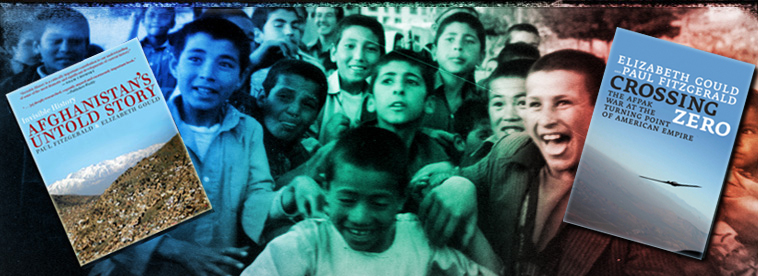
Invisible History: Afghanistan’s Untold Story
Crossing Zero The AfPak War at the Turning Point of American Empire
“Mysticism is just tomorrow’s science dreamed today.” Marshall McLuhan March 1969
Afghanistan and Mystical Imperialism: An expose of the esoteric underpinnings of American foreign policy
Afghanistan has always contained an esoteric element known to insiders. Now that “hidden” Afghan story is available to all who seek it. Our INN World Studio presentation of Afghanistan and Mystical Imperialism: An expose of the esoteric underpinnings of American foreign policy was filmed by Zev Deans & Jacqueline Castel and is available here. It will open the world to an Afghanistan most have never seen.
The Voice, the esoteric side of our Afghan experience as a novel
Invisible History: Afghanistan’s Untold Story
Crossing Zero The AfPak War at the Turning Point of American Empire
“Mysticism is just tomorrow’s science dreamed today.” Marshall McLuhan March 1969